
Key Takeaways:
- Consumers intentionally use tactics (like cart abandonment) to get better offers
- Common engagement signals are less reliable indicators of customer intent
- 40% of marketers report more work despite using AI and automation
- Personalization is widely used, but 64% of marketers say it lacks real impact
- Marketing teams need to improve how decisions are made—not just increase output
Marketing has spent the last decade getting faster, more automated, and more personalized. But new findings in our 2026 Customer Engagement Report reveal a much more fundamental change: Consumers have learned how marketing works, and they’re using that knowledge to their advantage.
From intentional cart abandonment to promotion cycling and strategic trial behavior, what looks like friction in the funnel is often something else entirely: adaptation. This article unpacks the key patterns emerging from the research—and what they signal about where marketing is falling behind.
How Consumers Learned to Game Marketing Systems
What the research ultimately reveals isn’t just a shift in preferences or expectations. It’s a shift in behavior—one grounded in a clearer understanding of how marketing systems operate. Consumers today aren’t simply moving through journeys designed by brands. They are engaging with those journeys deliberately, testing how systems respond, and adjusting their actions to get better outcomes. The result is a more capable, more strategic customer—one who is increasingly in control of how and when they engage.
That shift is already visible in how consumers engage.
1. Strategic engagement is becoming the default.
Many of the signals marketers have historically relied on—cart activity, trial starts, channel engagement—no longer carry the same meaning. Not because they’ve disappeared, but because consumers are using them differently.
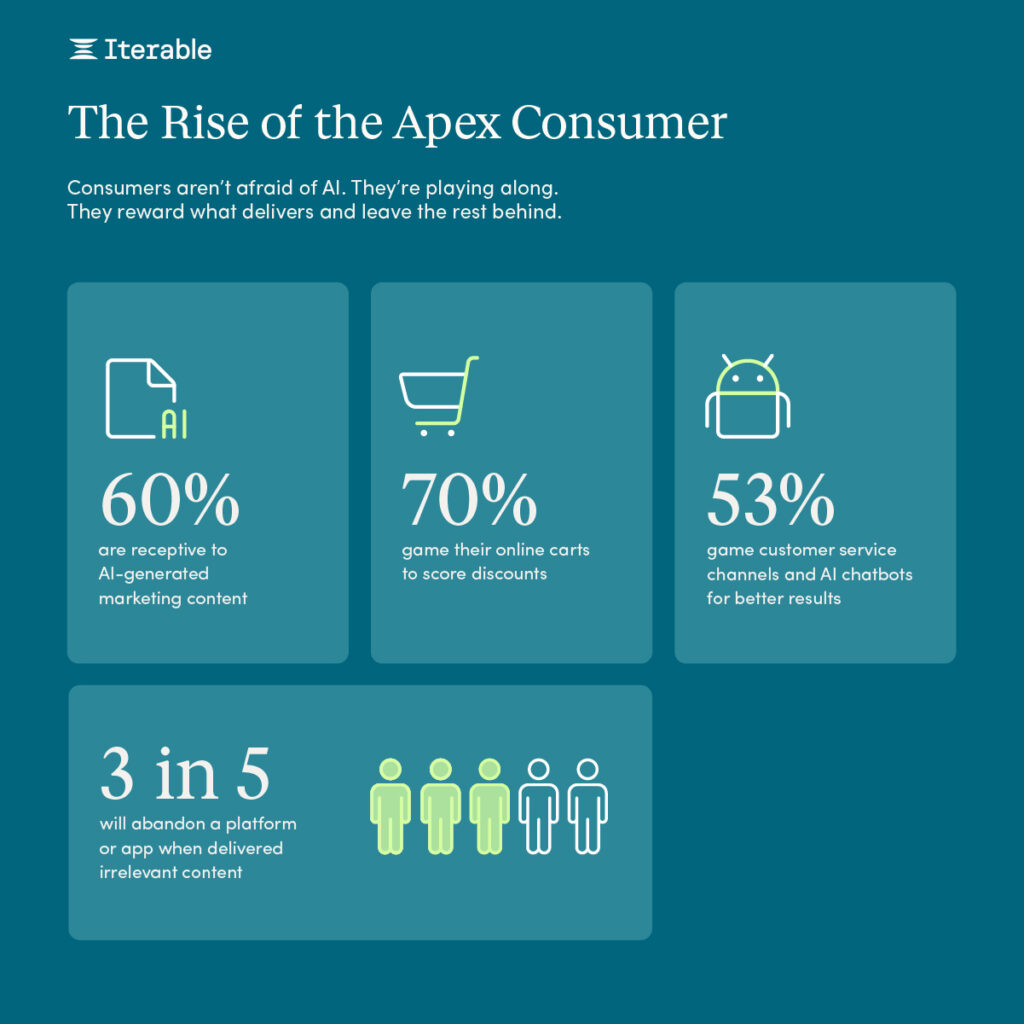
- 70% of consumers intentionally abandon carts to trigger discounts.
- 72% of consumers rotate between services based on promotional offers.
- 64% of consumers begin free trials expecting to cancel before renewal.
Consumers understand how marketing systems respond—and they are using that knowledge to influence outcomes. The journey is no longer something brands guide step by step. It’s something consumers actively navigate and game, based on what they expect the system will do next.
2. Openness to AI comes with higher expectations.
Consumers are not resistant to the technologies powering modern marketing. In fact, the data suggests a high level of openness—particularly when it comes to AI-driven experiences.
- 60% of consumers say they are receptive to AI-generated marketing content.
- 50% of consumers knowingly interact with AI during the shopping process.
This signals broad acceptance, but not blind trust.
- Over 33% of consumers cite data privacy and AI-generated misinformation as top concerns.
Consumers engage when AI improves the experience by making content more relevant, decisions easier, or interactions smoother. AI is not a differentiator on its own. It is part of the baseline experience, and it is evaluated accordingly.
3. Loyalty is more selective and easier to lose.
Brand loyalty is no longer reinforced through volume or visibility alone. It depends on delivering experiences that hold up over time, interaction by interaction.
- Three in five consumers have left a platform or brand over irrelevant content.
- Over half of consumers have been loyal to a brand they trust for more than 10 years.
These two dynamics operate together. High expectations create sharper drop-off, while consistent value earns long-term commitment.
What’s changed is the threshold for staying. Relevance, timing, and value are evaluated continuously, not periodically. A single interaction may not define the relationship, but patterns form quickly, and they determine whether a customer stays engaged or moves on.
Why Marketing Efforts Aren’t Translating Into Impact
If consumers have become more strategic, selective, and adaptive, the expectation would be that marketing systems evolve alongside them. The data shows a different reality.
Marketing has made significant gains in automation, scale, and output. But those gains are not translating into faster learning or more confident decision-making. In many cases, they are introducing new friction—slowing teams down at the moments where speed and clarity matter most.
The impact is already showing up in how marketing operates.
1. More output and complexity = more pressure.
AI and automation promised to reduce manual effort and increase efficiency. But for many teams, the opposite is happening.
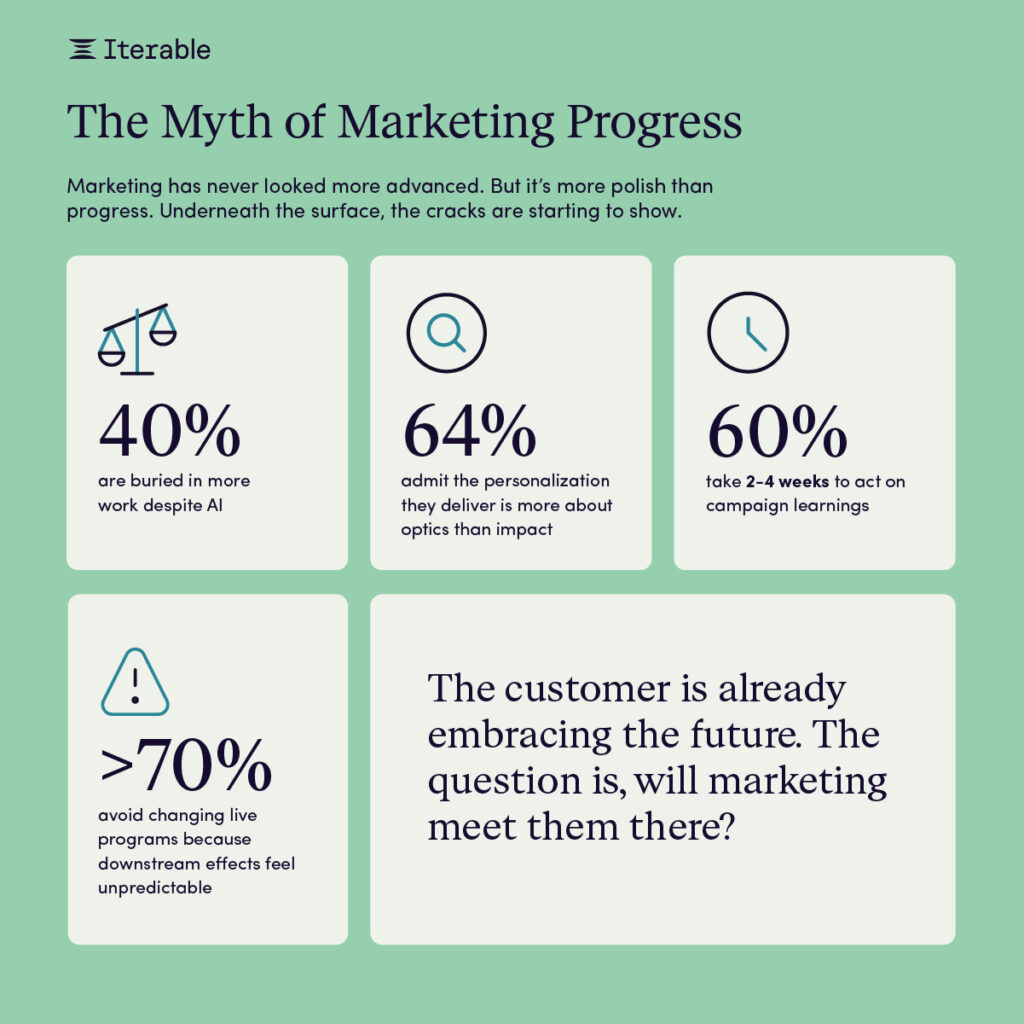
- 40% of marketers say they are buried in more work despite AI.
- < 18% of marketing teams actually use AI deeply in operations.
AI isn’t relieving the pressure where it needs to. As output increases, so does the complexity required to manage it—more campaigns, more variations, more coordination across teams and channels. Instead of simplifying execution, many systems are amplifying the operational load.
The result is a system that is active, but increasingly difficult to manage.
2. Personalization is visible but not effective.
Personalization is now a standard expectation across every channel. Most teams are delivering it in some form, but not at the level they know consumers expect.
- 64% of marketers admit their personalization is more about optics than impact.
- Only 2 in 5 marketers can explain the “why” behind personalization decisions.
Teams are producing personalized outputs without a clear decision framework behind them. Messages go out, but the reasoning doesn’t hold up. Without a defined “why,” there’s no way to evaluate, improve, or adapt what’s being sent.
The result isn’t just underperformance—it’s stagnation. Personalization scales, but it doesn’t get smarter.
3. Speed is constrained where it matters most.
Marketing is expected to respond in real time, but most systems are not designed to support that level of agility.
- 60% of marketers say it takes 2–4 weeks to act on campaign learnings.
- Over 70% of marketers avoid changing live programs because downstream effects feel unpredictable.
This creates a lag between insight and action. By the time a change is made, the moment has often passed. At the same time, uncertainty about system behavior discourages iteration, reinforcing a cycle in which teams maintain the status quo rather than improve it.
The Growing Gap Between Marketing and Customer Experience
Put the two sides together: consumers are becoming more strategic and adaptive, while marketing systems are becoming more active—but not more responsive. That’s where the gap emerges. You can see it in everyday scenarios:
- Discounts start to train customers to wait rather than convert.
- Journeys respond, but too late to influence the moment.
- Personalization is technically correct, yet misses the context that would make it matter.
Individually, these look like performance issues. Together, they point to a system-level mismatch. The system is reacting to the customer, while the customer is reacting to the system.
Frequently Asked Questions (FAQs) About Customer Engagement
1. Why is marketing becoming less effective despite more data and automation?
Marketing is becoming less effective because data and automation are being used to scale output, not improve decisions. 40% of marketers report more work despite AI, with most using it for execution rather than innovation. Meanwhile, consumers are using AI more strategically—testing systems and optimizing for better outcomes—making marketing efforts easier to undercut.
2. Why are traditional marketing signals like cart abandonment becoming unreliable?
Traditional signals are less reliable because consumers use them intentionally. 70% of consumers abandon carts to trigger discounts, and 64% start free trials expecting to cancel. These actions no longer reflect clear intent—they’re tactics used to influence outcomes, making surface-level signals harder to trust.
3. How is consumer behavior changing in response to modern marketing tactics?
Consumer behavior is becoming more strategic and selective. 72% of consumers rotate between services based on promotions, and 60% are open to AI-generated content when it adds value. Consumers test systems, time engagement, and optimize for better outcomes, making behavior less predictable and harder to influence.
4. What is causing the gap between marketing and customer experience?
Consumers are adapting in real time, but marketing systems are slower to respond. 60% of marketers take 2–4 weeks to act on insights, and 70% avoid changing live programs. This delay creates experiences that feel out of sync with customer expectations.
5. How can marketing teams adapt to more strategic and selective consumers?
Adapting requires rethinking how decisions are made and governed. Fewer than 18% of teams use AI deeply in decisioning, while many use it to scale output. To make AI effective, teams need clear frameworks for interpreting signals and making decisions in real time—otherwise, AI adds volume, not impact.
What It Takes for Marketing to Keep Up With Today’s Consumer
The gap isn’t caused by a lack of activity. It comes from how decisions are made.
Most marketing systems are designed to respond to events: a user takes an action, the system triggers a message. That approach works when behavior is predictable. It breaks down when customers are actively shaping outcomes—waiting, testing, and adjusting based on how the system responds. Closing the gap requires rethinking how signals are handled and how actions are triggered.
That means:
- Treating signals as inputs to evaluate—not instructions to execute
- Using context (recent behavior, history, timing) to determine what matters
- Making decisions closer to the moment, not weeks after the fact
This is a shift from running campaigns to managing decisions. Teams that continue to scale output will see diminishing returns. Teams that improve how decisions are made—what gets sent, when, and why—will shape the future of customer engagement.
Want to see the full picture? Dive into the 2026 Customer Engagement Report to explore the data behind the behaviors and bottlenecks defining marketing today. |