
Key Takeaways
- A successful digital marketing transformation starts with strategy, governance, and change management, not technology.
- Strong first-party data enables meaningful personalization, audience segmentation, and real-time customer engagement.
- Cross-functional alignment during discovery helps organizations avoid costly implementation mistakes.
- Modern marketing infrastructure creates new opportunities for experimentation, automation, and continuous optimization.
- Brands don’t need direct ecommerce sales to measure the impact of customer engagement and loyalty.
Marketing teams rarely wake up wanting to replace their technology stack.
More often, they reach a point where the limitations of their existing systems begin to shape what the business believes is possible. Personalization becomes too difficult. Segmentation requires manual work. Testing takes longer than it should. Instead of building better customer experiences, teams spend their time finding ways around the technology.
That was the challenge facing Penguin Random House UK, one of the world’s largest publishers. At Activate Tour London, Sybil Barker, Head of Digital Experience at Penguin Random House UK, and Gary Hanley, Co-Founder and Co-CEO of Heystack, shared how a two-year platform migration became something much larger: a company-wide transformation in how the organization understood, managed, and activated consumer relationships.
Their story offers an important reminder for any organization modernizing its marketing operations. Replacing an email platform is rarely the goal. The real objective is building the data, processes, and organizational alignment needed to create more relevant customer experiences today while preparing for the capabilities businesses will need tomorrow.
When Legacy Technology Becomes a Business Constraint
Penguin Random House’s biggest challenge wasn’t a lack of ambition. It was technology that couldn’t support it.
Managing 76 email programs across 13 publishing divisions should have enabled highly targeted reader experiences. Instead, the company’s legacy platform made core marketing capabilities difficult or impossible.
The biggest constraints were:
- Limited audience segmentation.
- Heavy manual processes.
- Little visibility into reader behavior.
- No practical foundation for personalization or loyalty.
The technology reflected a broader business model. Like many publishers, Penguin Random House had traditionally focused on retailers rather than direct relationships with readers. It had first-party data, but not the infrastructure to activate it. As third-party data declined, that limitation became increasingly difficult to ignore.
The consequences extended beyond marketing efficiency. Without meaningful segmentation or personalization, it was difficult to demonstrate the value of consumer marketing or justify investment in reader loyalty.

Replacing the platform wasn’t the goal. Building the foundation for modern marketing was.
Takeaway: Legacy technology doesn’t just slow execution. It limits an organization’s ability to understand customers, personalize experiences, and prove marketing’s impact.
Discovery Is the Most Important Phase of a Platform Migration
Many organizations treat discovery as a kickoff exercise.
Penguin Random House treated it as the project.
What began as a platform replacement quickly became a broader conversation about data, governance, processes, and organizational readiness. By slowing down early, the team avoided rushing into technology decisions that wouldn’t solve the underlying business challenges.
The discovery process brought together stakeholders from across the organization, including:
- Marketing and digital experience teams.
- Data engineering.
- Legal and InfoSec.
- Representatives from all 13 publishing divisions.
That cross-functional approach changed the project’s scope. Instead of asking, “What platform should we buy?” the team began asking, “What capabilities do we need to build?”
Gary Hanley believes that shift is why so many transformation projects succeed or fail.

Takeaway: Discovery isn’t project overhead. It’s where organizations build alignment, uncover hidden requirements, and define what success actually looks like.
Change Management Is the Real Migration
Modernizing technology is challenging.
Changing how an organization works is harder.
For Penguin Random House, the biggest obstacle wasn’t convincing people to adopt a new platform. It was helping teams across the business think differently about consumer data.
Historically, most decisions centered on retailer performance and transactional data. Building direct relationships with readers required new governance models, new data structures, and new ways for marketing, legal, engineering, and publishing teams to work together.
A cross-functional steering committee helped keep the transformation moving by creating shared ownership across the project. Rather than making technology decisions in isolation, leaders aligned priorities across digital media, consumer loyalty, digital experience, and their implementation partner.
That structure delivered two important benefits:
- Faster decisions through shared context.
- Fewer roadblocks between technical and business teams.

Takeaway: Platform migrations succeed when organizations modernize their operating model alongside their technology.
Infrastructure Unlocked Capabilities, Not Just Efficiency
Once Penguin Random House built the right foundation, the conversation shifted from what the platform couldn’t do to what the marketing team could now create.
Programs that had previously required manual effort or weren’t possible at all became part of the team’s everyday marketing toolkit.
Three capabilities stand out.
1. Real-Time Author Alerts
Readers can now subscribe to their favorite authors and receive an automated notification the moment a new title is released.
Instead of sending broad promotional campaigns, Penguin Random House can respond to an individual reader’s expressed interests in real time.
2. Smarter Audience Segmentation
For the first time, the team could see meaningful patterns within its audience data and test different messaging across segments.
Rather than assuming what readers wanted, marketers could experiment, measure engagement, and continuously refine campaigns based on performance.
3. Dynamic Book Recommendations
With more than 60,000 titles in its catalog, relevance matters. By combining browsing behavior with email engagement, Penguin Random House can recommend books based on a reader’s current interests instead of relying on static audience lists.
The team also discovered something unexpected.
Combining website behavior with email engagement revealed patterns in reader interests that had never been visible before, creating new opportunities for personalization and future campaign planning.
As Barker explained:
“The visibility of what our audience are doing and then how we can react and respond accordingly really has unlocked a lot for us.”
Takeaway: Modern marketing platforms create value by making customer behavior visible and actionable in real time.
Success Isn’t Always Measured by Revenue
For many brands, measuring marketing performance is straightforward. Someone clicks an email, completes a purchase, and revenue can be attributed directly to the campaign. Publishing doesn’t work that way.
A reader might discover a book through a Penguin Random House email but ultimately buy it from Amazon, a local bookstore, or another retailer. The purchase happens, but the revenue signal belongs to someone else.
That forced the team to rethink how success should be measured.
Instead of focusing only on revenue attribution, Penguin Random House began asking broader questions:
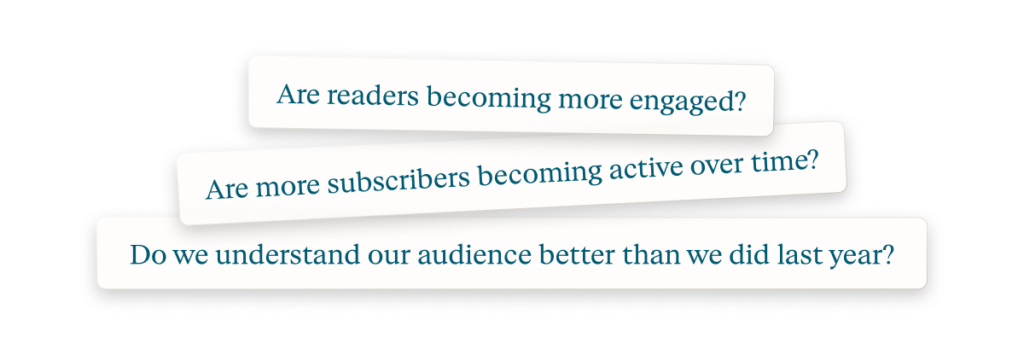
Those insights created value beyond marketing. Consumer behavior data could be shared with publishing divisions to inform future decisions, turning the marketing team into a strategic source of audience intelligence rather than simply an email team.
As Barker summarized the team’s mindset:
“Do we know more about our consumers than we did this time last year?”
Takeaway: Not every marketing program can measure direct revenue. Sometimes the most valuable outcome is a deeper understanding of your audience.
Operational Discipline Keeps Transformation Moving
A modern platform creates new possibilities. It also creates a long list of new ideas.
Penguin Random House quickly realized that prioritization would become just as important as innovation. Rather than pursuing every opportunity at once, the team used its cross-functional steering committee to sequence initiatives, align priorities, and keep the customer experience consistent across channels.
The team continually evaluated questions like:
- Should we invest next in audience acquisition?
- Do we need richer audience profiles?
- Is it time to expand activation across more channels?
That disciplined approach allowed Penguin Random House to keep learning while avoiding the temptation to scale faster than its foundation could support. Ongoing testing and measurement helped the team build a stronger case for future investment with every iteration.
Takeaway: Transformation doesn’t end after implementation. Sustainable progress comes from clear priorities, continuous experimentation, and a strong operational foundation.
The Best Marketing Capabilities Are Built on Strong Foundations
AI, personalization, and real-time marketing all promise better customer experiences. But Penguin Random House’s story demonstrates that those capabilities don’t begin with technology. They begin with the hard work of modernizing data, aligning teams, and building the operational foundation that makes personalization possible.
The organization’s two-year transformation offers three lessons that apply well beyond publishing:
- Invest in discovery before implementation.
- Treat change management as a core workstream.
- Measure progress by the quality of customer insight, not just immediate revenue.
With that foundation in place, Penguin Random House is now positioned to expand audience profiling, cross-channel personalization, and direct-to-consumer engagement with confidence.
Want to see the full transformation story? Watch the Activate Tour London session on demand.
Frequently Asked Questions (FAQs)
What is digital marketing transformation?
Digital marketing transformation is the process of modernizing the technology, data, and operating model that support customer engagement. As Penguin Random House’s experience shows, it’s as much an organizational change initiative as it is a technology project.
Why is first-party data important for personalization?
First-party data helps brands understand customer behavior and deliver more relevant experiences based on real interactions rather than third-party signals. It also creates the foundation for audience segmentation and real-time marketing.
How do brands measure marketing success without direct ecommerce sales?
Penguin Random House focused on engagement, audience intelligence, and brand loyalty instead of direct revenue attribution. Those insights helped demonstrate marketing’s value across the business, even when purchases occurred through retail partners.
Why is discovery important in a platform migration?
Discovery helps organizations align stakeholders, identify technical and operational requirements, and define the capabilities they want to build before implementation begins. It lays the foundation for a successful transformation.