
Key Takeaways:
- Marketing output is increasing, but efficiency and clarity are not
- AI is widely used, but fewer than 18% apply it to real decisioning
- Personalization is widespread, but 64% of marketers say it lacks impact
- Slow execution is a major blocker, with most changes taking weeks
- Teams are hesitant to change, with over 70% avoiding live updates
Marketing has spent years investing in AI, automation, and personalization. But according to our 2026 Customer Engagement Report, more capability hasn’t necessarily translated into more agility.
Because while consumer behavior has evolved quickly, marketing systems haven’t kept pace in the ways that matter. What looks like advancement is often just more activity.
In the first article in this series, we looked at how consumers have become more strategic and adaptive. In the second article, we unpacked how those behaviors show up in practice.
This piece looks at the other side of that equation: marketing itself.
Where Marketing Breaks Down in Practice
If consumers are becoming more adaptive, the natural question is: why isn’t marketing keeping up?
The answer isn’t a lack of tools or effort. It’s how modern marketing systems actually operate under pressure. The same infrastructure designed to scale engagement—automation, personalization, AI—has introduced new constraints around speed, clarity, and control.
What follows isn’t a list of isolated challenges. It’s a set of patterns that show up consistently across teams:
1. Why AI Hasn’t Reduced the Marketing Workload
AI was supposed to reduce workload and unlock smarter execution. Instead, most teams are using it to keep up with demand.
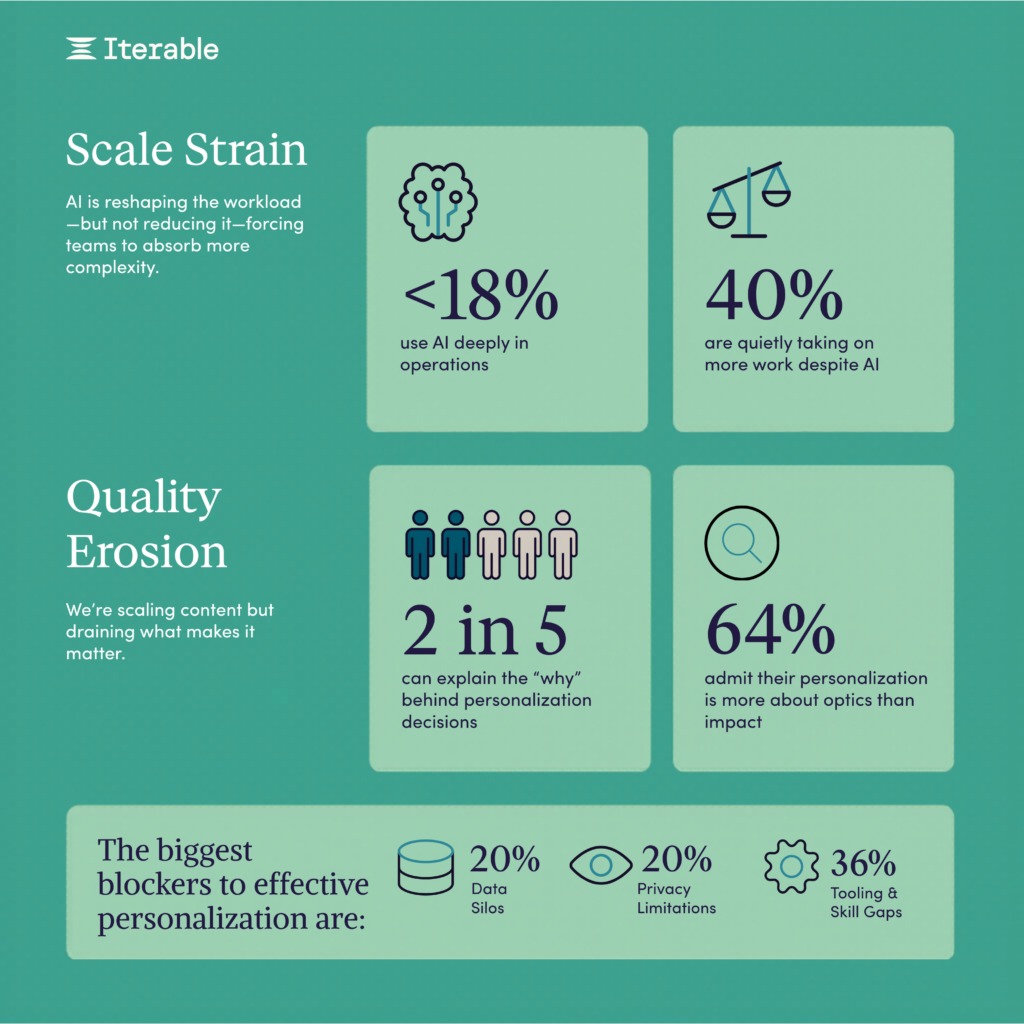
- 67% of marketers are doing more with fewer resources
- 40% of marketers say they’re taking on more work despite AI
- Less than 18% of marketers use AI deeply in operations
The issue isn’t access to AI. It’s how it’s applied. Many marketers use AI to generate content or accelerate tasks. But the harder problems—decisioning, orchestration, optimization—are still largely manual.
So output increases, but the system behind it doesn’t get simpler. It gets heavier. More campaigns to manage. More variations to coordinate. More pressure to maintain performance.
In the end, AI isn’t removing complexity. It’s exposing it.
| What Needs to Change About How AI Supports Marketing Teams The opportunity now is not just to generate more with AI, but to use it to reduce operational friction. The teams making the most progress are applying AI more deeply to orchestration, prioritization, and decision-making. That shift requires systems that can interpret signals in context and help marketers act with greater clarity, not just greater speed. |
2. The Problem With Personalization at Scale
Personalization has become a baseline expectation. Most teams are delivering it across channels. The problem is whether it holds up.
- 64% of marketers say personalization is more optics than impact
- Only 2 in 5 marketers can explain the “why” behind their decisions
Without a clear decision framework, personalization becomes guesswork. Messages may look tailored, but they lack the reasoning needed to improve over time.
There’s also growing tension around how far personalization should go:
- 39% of marketers are concerned that hyper-personalization feels intrusive
- 43% of marketers worry that personalization raises privacy concerns
So teams are caught in the middle, expected to deliver relevance, but without the clarity or confidence to do it consistently.
| What Needs to Change for Personalization to Feel Relevant Closing that gap requires more than adding data points or dynamic fields. It requires a clearer understanding of why decisions are being made in the first place. As personalization becomes more automated, explainability and transparency become increasingly important—not just for marketers trying to optimize performance, but for consumers deciding whether an experience feels helpful or invasive. |
3. The Operational Lag Slowing Modern Marketing
Consumers are making decisions in real time by testing systems, waiting for offers, switching channels. The same can’t be said for all marketing teams.
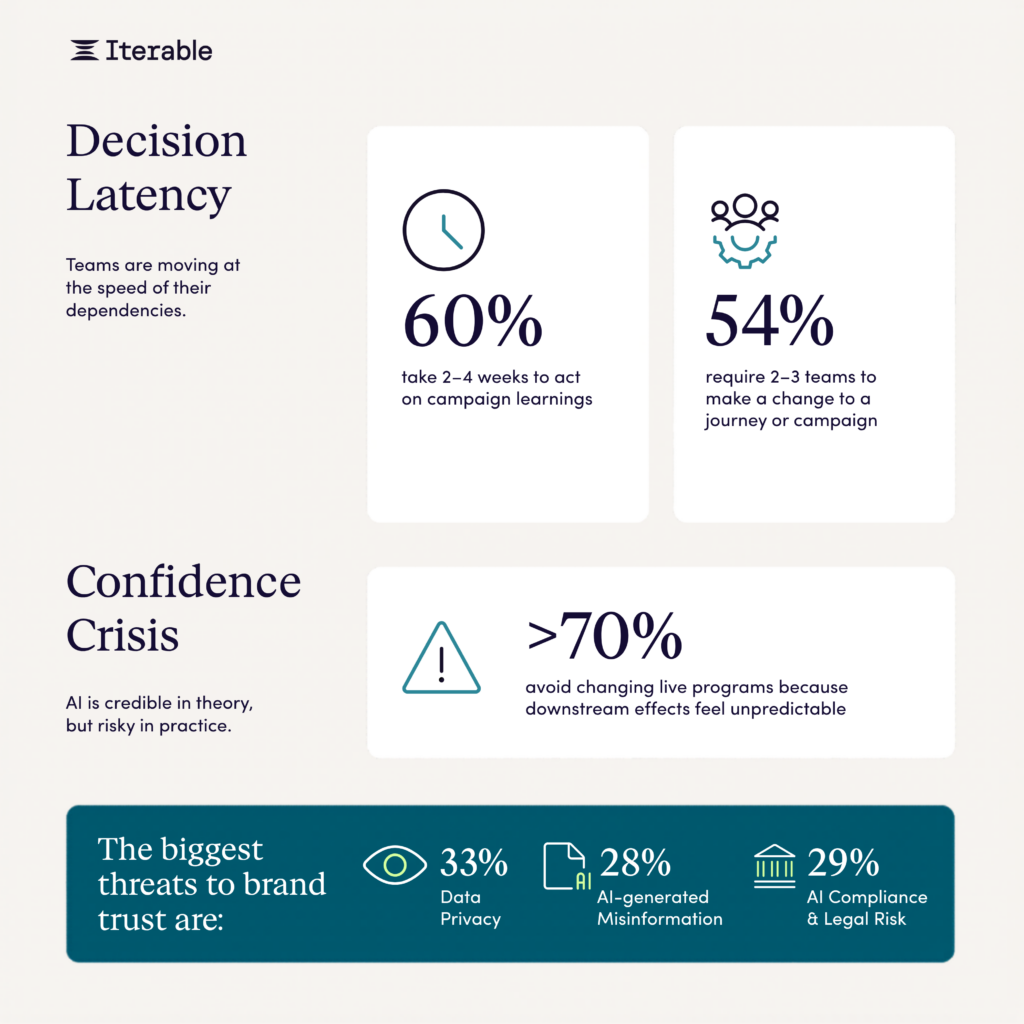
- ~60% of marketing teams take 2–4 weeks to act on campaign learnings
- Only 30% of marketing teams are able to act on insights within days
- 54% of brands require 2-3 teams to make a change
This creates a lag between insight and action. Even when teams know what needs to change, the process slows them down, from handoffs and approvals to dependencies across tools and teams. By the time updates go live, behavior has already shifted. And instead of adapting quickly, teams default to maintaining what’s already running.
| What Needs to Change for Faster Marketing Execution Faster marketing doesn’t come from pushing teams harder. It comes from reducing the friction between insight and action—giving teams unified visibility into customer behavior, continuously optimizing as signals change, and creating systems that can respond in the moment instead of waiting for the next review cycle. |
4. Why Marketing Teams Hesitate to Trust AI
AI is widely seen as the path forward for marketing. In fact, 70% of marketers trust AI analytics as much as or more than humans. But how it’s being used tells a more cautious story. When asked what the biggest threats are to consumers’ ability to trust brands:
- 33% of marketers cite data privacy as a top concern
- 28% of marketers point to AI-generated misinformation
- 29% of marketers highlight compliance and legal risk
These concerns shape how teams operate. AI is often used to scale output, not guide decisions. The result is a system that hesitates.
- Over 70% of marketers avoid changing live programs due to unpredictable downstream effects
- 35% of marketers say the biggest barrier to autonomy is unclear ownership when something goes wrong
- 30% of marketers cite a lack of trust in how AI decisions are made
Even when teams have the tools and insights, uncertainty keeps them from acting in the moment. AI is present—it’s just not fully operational.
| What Needs to Change for Teams to Trust AI Systems That’s why explainability is becoming foundational to modern marketing systems. As AI takes on a larger role in decision-making, marketers need visibility into why actions are happening, how recommendations are generated, and where accountability lives. Trust is no longer just about performance. It’s about transparency. |
Frequently Asked Questions (FAQs) About AI and Marketing Performance
1. Why does marketing feel more complicated despite AI?
AI has increased marketing output, but not necessarily operational simplicity. 67% of marketers say they’re doing more with fewer resources, and 40% report taking on more work despite AI. Most teams still use AI for content generation and task acceleration rather than real-time orchestration, optimization, or decision-making.
2. Why does personalization still feel generic?
Most teams can personalize content, but fewer can continuously adapt it based on changing behavior. 64% of marketers say their personalization is more about optics than impact, often because data is fragmented or updates happen too slowly to stay relevant in the moment.
3. Why are marketing teams slow to make campaign changes?
Most marketing teams were built to execute campaigns, not continuously adapt them. About 60% take weeks to act on campaign learnings, and more than half require multiple teams to make changes. That slows response time just as customer behavior becomes more dynamic. Reducing that lag depends on faster access to customer data, fewer operational handoffs, and systems that can optimize continuously instead of relying on periodic manual updates.
4. Why are marketers hesitant to use AI for decision-making?
Trust breaks down when teams can’t clearly understand how decisions are made or who owns the outcome. 35% of marketers cite unclear ownership as the biggest barrier to autonomy, while 30% point to a lack of trust in AI-driven decisions. Explainability and transparency are becoming essential for AI adoption at scale.
5. What’s actually preventing marketing from keeping up with consumers?
Consumers get familiar with predictable tactics. Discounts, win-back flows, and promotional timing start to lose effectiveness once people learn how they work. Over time, engagement drops because the experience becomes too repetitive. Keeping campaigns effective requires ongoing testing, faster iteration, and systems that can adjust based on changing behavior instead of repeating the same sequence every time.
Marketing Was Built to Scale. Now It Has to Adapt.
Most marketing systems were designed for predictability: fixed journeys, scheduled optimization, repeatable campaigns. Consumers no longer behave that way. They adjust quickly, react in real time, and change behavior faster than most teams can respond.
That’s the gap this research points to:
- AI increases output, but not clarity
- Personalization scales, but doesn’t improve
- Insights exist, but action is delayed
- Systems run, but teams hesitate to change them
Now the advantage goes to teams that can interpret signals, act in the moment, and adapt as behavior shifts—not weeks later. In the final article in this series, we’ll look at what it takes to build for that shift.
See what’s really slowing modern marketing down. Dive into the 2026 Customer Engagement Report to explore the data behind today’s marketing challenges. |