
Lately, we’ve been getting a lot of questions about non-human interactions in email – bot clicks, inflated open rates, and the general reliability of engagement metrics.
It’s a fair question and one that deserves some clarity.
What’s a Non-Human Interaction Anyway?
When we talk about “non-human interactions” in email, we’re referring to things like automated opens or clicks that don’t come directly from a person.
These are actions triggered by systems, privacy features, security tools, spam filters, or mailbox providers that scan or pre-load parts of your email (like images or links) before the recipient ever sees it.
For the most part these actions are designed to protect users — but they also make traditional marketing metrics feel a little messy.
|
What is a non-human interaction? A non-human interaction is an email event — like opens or clicks — caused by privacy tools or spam filters, not an actual person. |
Like most things in email, there are two sides to this.
We hear it all the time: “What are you doing to fix bot clicks?” and we get it.
For marketers, inflated opens or bot clicks can make data feel unreliable. For some, clicks drive their business model. Others rely on opens to power segmentation or automation.
Let’s take a step back.
A Brief History of the Open Rate
Historically, the open rate has never been a perfect signal of engagement. But there was a time when it felt like a more reliable one.
Back When Open Meant Interested
That’s because, years ago (showing my career age, and yes I found the fountain of email youth), tracking an open usually relied on someone taking action — like clicking “view images” in their inbox. If images didn’t load automatically, an open required curiosity or intent.
Marketers leaned on this signal. It wasn’t perfect — but it gave them a directional gauge: “Did someone want this email?”
Most were casting the widest net possible and hoping a big open number would yield results.
BUT… the ecosystem evolved.
The First Big Shakeup – Gmail Proxies
Back in December 2013, Gmail made a big move: it started serving all images in emails through its own image proxy by default.
This was a win for users — proxies help ensure that images are safe and secure (they’re scanned for malware or viruses before ever reaching the inbox). But for marketers? It was a mixed bag.
On the plus side:
- Emails became more visual again.
- Mobile-responsive design was on the rise.
- Marketers could worry less about asking people to “enable images.”
On the flip side:
- User-level data like device type and location disappeared (everything started showing Google’s server location in Mountain View).
- Open rates inflated artificially, especially for low-engagement senders.
- Signals were skewed by proxies preloading images rather than human behavior.
But it’s worth remembering — back in 2013, Gmail didn’t have the dominant market share (6%) it holds today. So while overall industry open rates didn’t spike overnight, senders who leaned heavily into this mailbox provider saw performance metrics take off.
In many ways, it created a false sense of success. The numbers looked better — but user behavior hadn’t fundamentally changed. Just the way it was measured.
Contrast that with services like DuckDuckGo, which took the opposite approach and didn’t pass any open data back to marketers. While Gmail’s proxy boosted open rates, DuckDuckGo prioritized user privacy by offering no tracking visibility at all. This difference in approach foreshadowed the sweeping changes Apple would soon introduce.
Apple MPP Changes Opens Forever
By the time Apple introduced Mail Privacy Protection (MPP) in 2021, many mailbox providers had already adopted proxies, but MPP took the impact of inflated open rates to a whole new level.
MPP preloads content — including images and tracking pixels — in the background, meaning Apple users’ emails are marked as “opened” even if they haven’t interacted with the email.
“For marketers…engagement metrics became more unreliable, as higher open rates no longer equated to real human interaction.”
As a result, open rates spiked almost overnight, making this vanity metric even harder to interpret. Unlike previous changes, Apple’s far-reaching influence affected a large portion of the email landscape. For marketers, this meant engagement metrics became more unreliable, as higher open rates no longer equated to real human interaction.
Opens Are Still a Signal—Just a Different One
But I’d argue that open rates still hold directional value. In a way, we could view opens as an indicator of inbox placement.
Today, I think of opens kind of like a billboard on the freeway — you know it’s there, you know people see it — but can you say exactly how many people read every word? No.
“Opens are now a sign of placement, presence, and potential interest.”
Static billboards get more views simply because they are always visible, while digital billboards rotate content — so the message seen depends on timing and chance. That’s how I think of opens now — a sign of placement, presence, and potential interest — but not a true read.
But Why Are My Clicks Randomly High?
I get it. As a marketer, you want reliable data. You want to know real people are engaging with your email, and if it’s a bot inflating your click rates or triggering automations, that’s frustrating.
Remember — the primary job of a mailbox provider is to protect their users from spam, phishing, and harmful content. At Yahoo, for example, ~90% of inbound mail traffic is spam. Their filters must work hard to determine what’s safe and what’s not.
Why Your Links Might Get Pre-Clicked
Part of that process involves validating that the links in your email are safe. Mailbox providers may “click” every link in your email during scanning. This isn’t engagement—it’s a security check.
Here’s when it’s most likely to happen:
- You’re using a new or untrusted sending domain
- Your email includes shortened or third-party URLs
- You link to external sites (not your brand domain)
- You’re sending to users in high-security environments like finance, government, or education
In these cases, filters run automated checks—opening and clicking links on your behalf to assess safety, which is why you’ll sometimes see every link in your email “clicked” before the user even opens it.
It’s Not Personal – It’s Protective
Here’s the thing: mailbox providers aren’t trying to game your metrics –– they’re trying to protect their users
This is where I like to use the airport analogy. Think about security at the airport. TSA isn’t searching bags because they think you personally are a threat; they’re doing it because of the environment they operate in — thousands of people moving through, some risk involved, and their job is to keep everyone safe.
Mailbox providers/filters operate the same way. Their users are walking through a digital airport — and before allowing them to “exit” and click on your links, those links might get scanned, checked, or sandboxed.
Is it perfect? No. But it’s necessary.
AI Tools Are Distorting Your Metrics
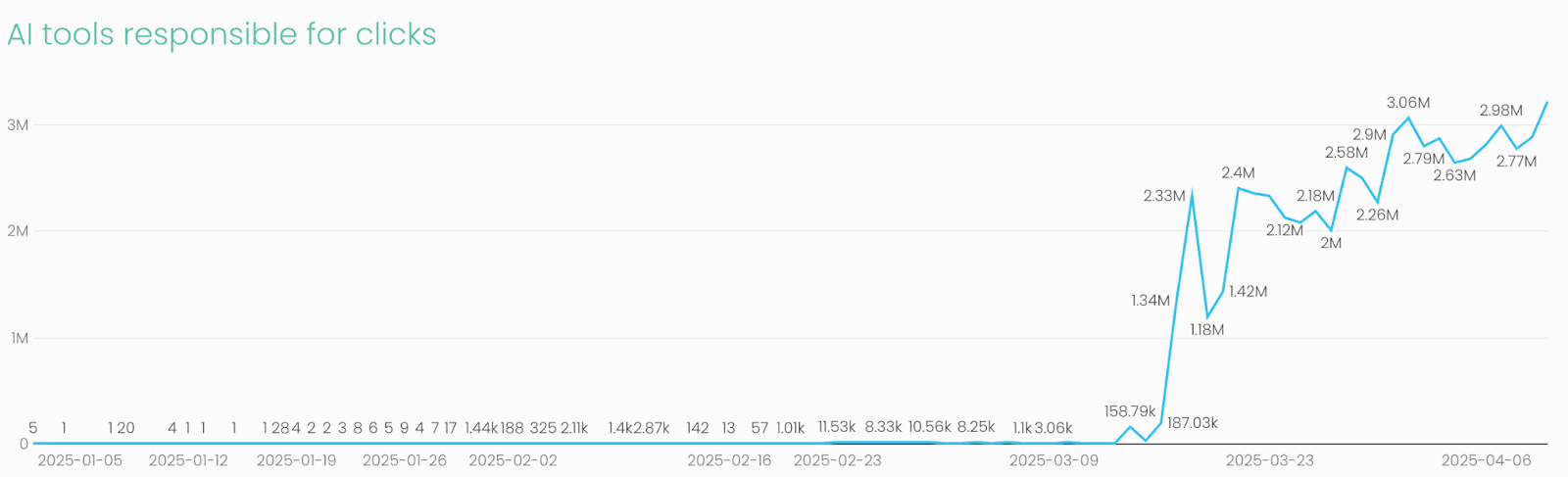
Marketers everywhere are leaning hard into AI tools—and now, those tools are starting to show up in engagement data, literally. We’ve been tracking it, and what we’ve seen over the last few months is wild.
In early 2025, we began noticing something unusual: user agent strings tied to AI tools like ChatGPT and ClaudeBot were appearing in click tracking across marketing emails. At first, it was a trickle. But by mid-March, it was a flood—peaking at more than 3 million clicks in a single day.
Example User Agent String:
Mozilla/5.0 AppleWebKit/537.36 (KHTML, like Gecko; compatible; ClaudeBot/1.0; +claudebot@anthropic.com)
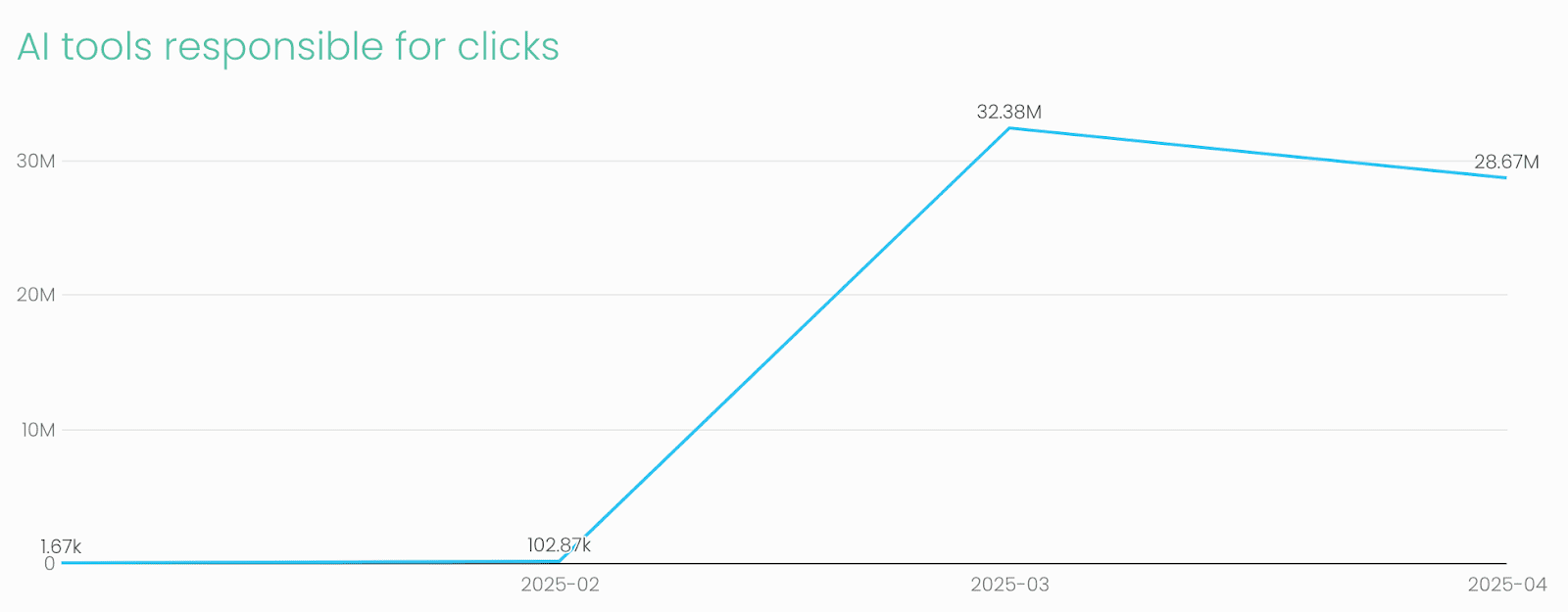
When aggregated by month, the growth curve speaks for itself…We’ve entered a new era.
Turns Out, It’s Us
Non-human activity isn’t just happening to marketers anymore — it’s happening because of the tools marketers are using. When we feed emails into AI tools to summarize or analyze them, those tools are clicking the links to “see” what’s behind the message. But when those clicks get logged just like any other user interaction, it becomes harder to distinguish real engagement from machine behavior.
The irony? In the quest to optimize, marketers might be contributing to the same bot-like behavior we’ve spent years trying to detect and filter out.
That’s not inherently bad. But it does mean we all need to get smarter about how we interpret engagement metrics in this new landscape.
Opens and clicks still matter — but context matters more.
“Non-human activity isn’t just happening to marketers anymore — it’s happening because of the tools marketers are using.”
Bringing Clarity Back to Email Engagement
If your engagement metrics have felt a little off lately, you’re not alone. With more automated scanning in play, it’s become harder to distinguish real human interactions from machine-triggered events.
That’s why our product team has been building smarter ways to help you see through the noise. Phase 1 of our engagement clarity updates is live, introducing: Filtered click metrics for email and SMS
- Total Emails Clicked (filtered)
- Unique Email Clicks (filtered)
- Total SMS Clicks (filtered)
- Unique SMS Clicks (filtered)
These metrics filter out clicks from newly identified bot user agents to better reflect genuine engagement insights, which are available across Campaign Analytics, including heatmaps and Messaging Insights.
This is just the beginning. As the email ecosystem continues to evolve, so will our tools — always with the goal of giving you cleaner data, sharper insights, and a deeper understanding of what meaningful engagement looks like today.