
Key Takeaways:
- Consumer behavior now changes faster than most marketing systems can respond
- AI increases output, but adaptability still depends on decision speed and system design
- Static journeys and fixed optimization cycles are becoming less effective
- Adaptive marketing systems learn from signals and respond in real time
- The advantage now goes to teams that can reduce the gap between insight and action
Marketing systems were built for predictability. Iterable’s 2026 Customer Engagement Report revealed that consumers no longer behave that way.
In the first article in this series, we explored how consumers learned to navigate marketing systems to their advantage. In the second, we looked at why marketing organizations are struggling to keep pace despite more AI, automation, and personalization.
Now the challenge is becoming clearer: modern marketing requires systems that can adapt as behavior changes. This is the next shift in customer engagement. Not just more automation, but systems that learn, adjust, and improve continuously.
Why Static Marketing Systems Are Breaking Down
Most marketing systems were built around predictable behavior. A customer enters a journey, moves through a sequence, and responds in ways the system can anticipate. The problem is, consumer behavior no longer stays predictable long enough for that model to work consistently.
Today’s consumers:
- Test incentives instead of responding to them
- Delay purchases to trigger better offers
- Switch channels based on convenience and timing
- Re-engage only when the value feels worthwhile
What once looked like intent now often reflects strategy instead. That creates a structural problem for teams operating on fixed logic. By the time many teams identify a pattern, approve changes, and update campaigns, customer behavior has already shifted.
The data already points to the operational impact:
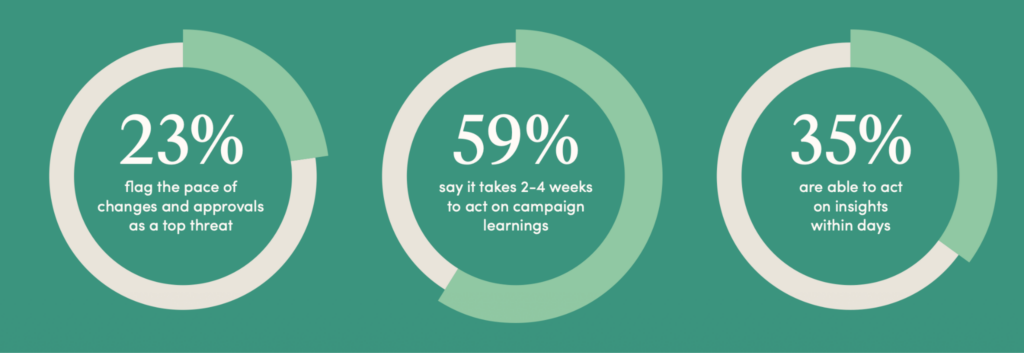
- ~60% of marketing teams take 2–4 weeks to act on campaign learnings
- Only 35% of marketing teams can act on insights within days
- 54% of marketing teams require 2–3 teams to make a change
The result is growing decision latency. Teams know what needs to change, but the system around them moves too slowly to respond while intent is still active. The brands adapting fastest are changing how engagement works operationally.
| How Wolt Made Personalization More Responsive Take food delivery service, Wolt, for example: they saw the limits of static personalization as the company expanded across countries, cities, and customer segments. Using Iterable’s Predictive Goals, the team shifted toward a more responsive model. Instead of relying on broad audience assumptions, Wolt could identify which users were most likely to: – Place another order – Try a new service – Become paying subscribers That shift reduced campaign production time from an hour to roughly five minutes while helping increase revenue and first-time retail conversions in key markets. |
Why More AI Hasn’t Solved the Problem
AI increased marketing output. It didn’t automatically make marketing systems more adaptive. Most teams now create more campaigns, journeys, and channel touchpoints. But many are still struggling to respond faster when customer behavior changes.
The report data shows the disconnect:
The issue isn’t access to AI. It’s how AI gets applied. For many organizations, AI still isn’t supporting marketers where it’s most needed, and not at the scale that it should be to make a difference in their day-to-day lives.
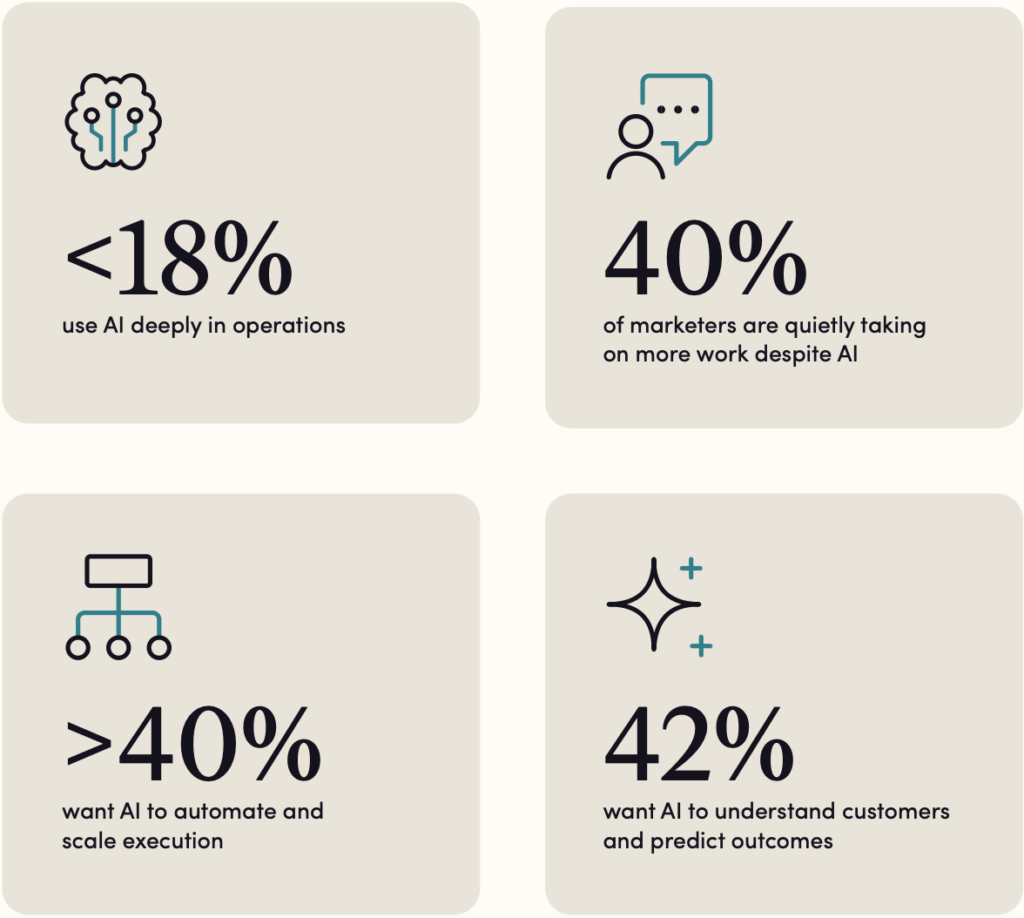
- Less than 18% of marketing teams use AI deeply in operations like orchestration, segmentation, and optimization.
- Only 15% rely heavily on AI for content generation, even though content creation remains the single biggest daily time drain.
- Over 40% of marketers actually want AI to automate campaigns and decode customer behavior.
The appetite for AI is there, and the teams making the most progress are using AI differently.
| How Therabody Moved Beyond Static Personalization Wellness tech brand, Therabody, realized its personalization relied heavily on basic profile data and single-channel engagement that struggled to keep pace with evolving customer interests over time. To improve relevance, the team shifted toward a more behavioral model built around customer preferences, real-time engagement signals, and behavior-based timing. That shift helped Therabody build a clearer understanding of evolving customer intent, leading to: – A 45% higher conversion rate – A 27% increase in SMS click-through rates – A 12x increase in customers with clearly defined interests and needs |
What Adaptive Marketing Systems Actually Do Differently
Adaptive marketing systems don’t rely on a fixed sequence of actions. They continuously reevaluate what customer behavior means in the moment. The goal isn’t to automate every decision. It’s to reduce the gap between behavior and response.
Someone may browse repeatedly without purchasing, switch between channels throughout the day, or disengage entirely until the timing feels right. Static journeys struggle with that variability because they depend on predefined paths.
Adaptive systems respond differently:
- Timing changes based on engagement patterns
- Messaging adjusts as intent shifts
- Channel decisions evolve alongside behavior
- Optimization happens continuously instead of periodically
With the right foundations, adaptive systems help marketing teams operate with more confidence by making decision-making more responsive, consistent, and transparent.
| How Tandem Built More Contextual Customer Journeys Language Exchange Platform, Tandem, found that static upgrade prompts, emails, and push notifications were interrupting the user experience instead of responding to it in context. To improve relevance, the team rebuilt its approach around real-time behavioral signals captured across the product experience, using customer activity like abandoned payments, feature usage, subscription timing, and in-app engagement to trigger more contextual messaging. The results were: – A 10% increase in subscription revenue – A 10x increase in conversion rates among high-intent audiences – > 10x reduction in production time through reusable workflows and embedded messaging templates |
What Marketing Teams Need to Change Now
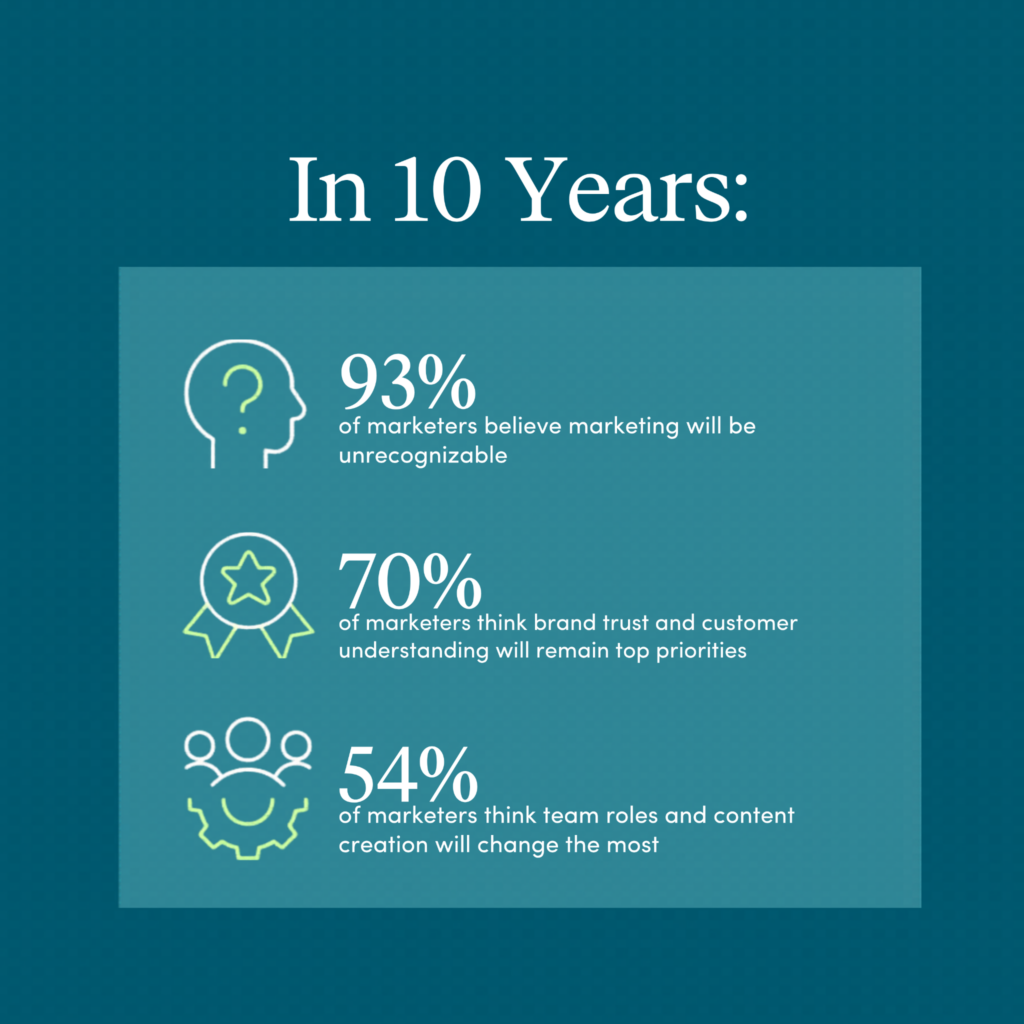
Marketers already see how significant this shift will be. In fact, 93% believe marketing will become unrecognizable within the next decade, while 70% say brand trust and understanding customer behavior will remain top priorities.
The fundamentals of marketing are holding steady. What’s changing is how engagement systems need to operate as consumers move faster, adapt faster, and react in real time.
The organizations moving fastest are shifting their operating model in a few important ways:
1. Get Smarter with Every Signal.
Signals across channels, sessions, and moments of engagement help shape what happens next, allowing systems to respond while intent is still active instead of waiting for the next optimization cycle.
- Every interaction informs the next decision. Cart abandonment, channel switching, and engagement timing all help shape future messaging and offers.
- Personalization becomes easier to adjust over time. Teams rely less on hardcoded journeys and more on flexible decisioning systems that can evolve with behavior.
- Optimization happens continuously. Messaging, timing, frequency, and channel decisions adjust while campaigns are still live.
2. Build For What Breaks the Rest
Adaptive brands respond by designing systems that can hold up as behavior changes, varying engagement patterns over time instead of relying on repeatable tactics customers eventually memorize.
- Measure long-term engagement durability. Teams evaluate whether engagement holds over time and across channels, not just during short-term spikes.
- Engagement patterns become less predictable. Timing, sequencing, and incentives shift based on live behavior instead of repeating the same playbook.
- Pressure-test before scaling. Adaptive teams validate changes in smaller environments before rolling them out broadly.
3. Redesign How Decisions Happen
Adaptive teams reduce friction by defining strategy, guardrails, and accountability upfront so systems can optimize within clear boundaries while marketers focus on oversight, judgment, and direction.
- Humans and AI operate with clearer roles. Teams define strategy and guardrails while systems handle optimization and execution.
- Teams spend less time re-deciding the same things. Systems adjust within predefined parameters instead of requiring constant manual intervention.
- AI decision-making becomes easier to understand. Marketers can see why decisions are happening, where automation applies, and when oversight is needed.
That shift is becoming foundational to modern customer engagement. As consumer behavior grows less predictable, the advantage increasingly belongs to teams that can learn and adapt while engagement is still happening.
Frequently Asked Questions (FAQs) About Adaptive Marketing
1. What is adaptive marketing?
Adaptive marketing continuously adjusts messaging, timing, and channel decisions based on changing customer behavior. Instead of relying on fixed journeys, adaptive systems respond to live signals as engagement patterns evolve.
2. Why are traditional customer journeys becoming less effective?
Consumers now delay purchases, switch channels, test incentives, and engage on their own timing. Static journeys struggle because they rely on assumptions that often change before campaigns can adapt.
3. What is decision latency in marketing?
Decision latency is the gap between recognizing a customer behavior shift and acting on it. Many teams still depend on approvals, disconnected tools, and slow optimization cycles before changes go live.
4. Why doesn’t AI automatically improve customer engagement?
AI can increase output, but output alone doesn’t create adaptability. Many teams still use AI for content generation rather than decision-making, orchestration, or real-time optimization.
5. How can marketing teams respond faster to changing customer behavior?
Teams improve responsiveness by reducing the friction between insight and action. That includes evaluating signals continuously, optimizing campaigns while they are live, and coordinating decisions across channels as behavior changes.
The Future of Marketing Is Adaptation
Consumers have already adapted to modern marketing systems. They learned how incentives work, how journeys behave, and how to engage on their own terms.
The teams pulling ahead are evolving alongside them by building systems that can continuously interpret behavior, adjust decisions in context, and respond while intent is still active. AI plays a role in that shift, but only when it helps marketers reduce friction, improve coordination, and adapt faster as customer behavior changes.
The future of customer engagement won’t belong to the teams running the most campaigns. It will belong to the teams that can adapt while behavior is still unfolding.
| Explore the full 2026 Customer Engagement Report to see how leading brands are adapting their marketing systems for a faster, less predictable customer environment. |