
The Sports MarTech Playbook for Year-Round Revenue
Nine Game-Day and Off-Season Plays and the Tech Stack to Run Them
Table of Contents
Big moments start the fan relationship. What you do next decides how long it lasts.
When a buzzer-beater lands, a trade breaks, or an athlete makes history, fan excitement peaks within seconds. The teams and leagues that come out ahead do more than just show up in that moment. They use it to learn who their fans are, which players and teams they follow, and what will keep them coming back. Then they carry that relationship from draft day through the off-season.
That’s easier said than done. When fan data updates only once a day, ticketing and merch information lives in separate systems, and campaigns have to be built by hand, it’s hard to respond in the moment and even harder to keep fans engaged after the final whistle blows.
This playbook is your blueprint for doing both.
Built specifically for lifecycle marketers, CRM managers, and digital leaders, The Sports MarTech Playbook for Year-Round Revenue breaks down how leading sports organizations close the gap between a fan’s action and their response, put what fans tell them and do with them to work right away, and turn short-lived game-day excitement into steady engagement and year-round revenue.
Macro Pressures: Four Shifts Raising the Stakes
- Thin First-Party Data: Privacy rules and browser tracking limits make rented social and ad audiences less reliable. Unifying first-party data across ticketing, stadium WiFi, apps, and merchandise is now foundational to building enterprise value.
- Regional Sports Networks (RSN) Restructuring: Regional Sports Networks are restructuring, shrinking local TV revenue and reducing the reach of broadcast audiences for many club teams. As media rights evolve, direct-to-fan digital relationships have become essential for sustained revenue growth.
- The “Home vs. Venue” Experience Gap: As ticket and concession prices rise, every home game also competes with the fan’s couch. Fans compare the in-person venue experience to watching from home on a 75-inch 4K TV with no lines, cheaper concessions, and instant replays. Venues must prove their value through seamless, personalized experiences that cannot be replicated at home.
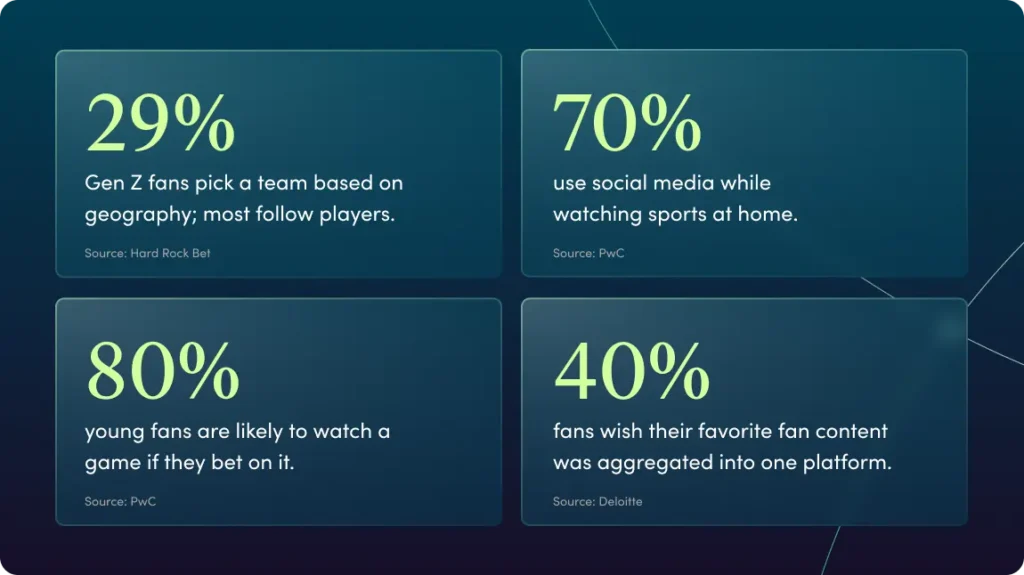
- The Fragmented Fan: Younger audiences follow individual athletes over sports franchises, consuming short-form video and second-screen content (betting, fantasy, social) rather than sitting through three-hour broadcasts.
Growing Core Revenue Through Direct Fan Relationships
Ticketing, sponsorship, and media rights still drive the most revenue in sports. What’s changed is how teams grow them: through a direct connection with every fan. The teams winning today combine what fans tell them (zero-party preferences) with what fans do (real-time behavior across ticketing, guest WiFi, mobile apps, and venue transactions) to turn scattered touchpoints into higher gate revenue, stronger sponsorship value, and lifelong fandom.
Moving Beyond Transactional Engagement
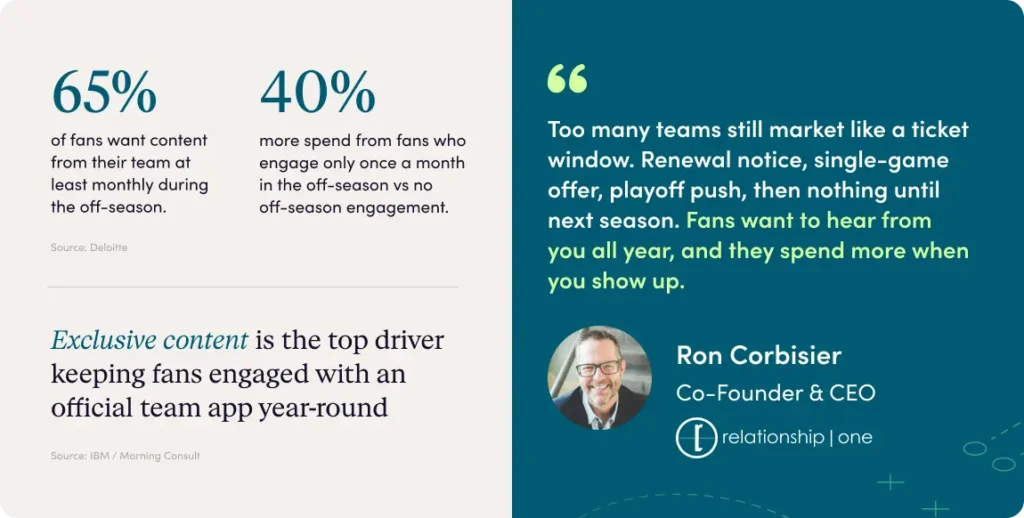
Traditional campaign calendars treat fan relationships as episodic transactions, focusing outreach heavily on ticket sales while staying silent during key retention windows. Closing this gap means rethinking the communication model itself, and shifting to continuous, year-round engagement.
Turning Signals Into Profile Intelligence
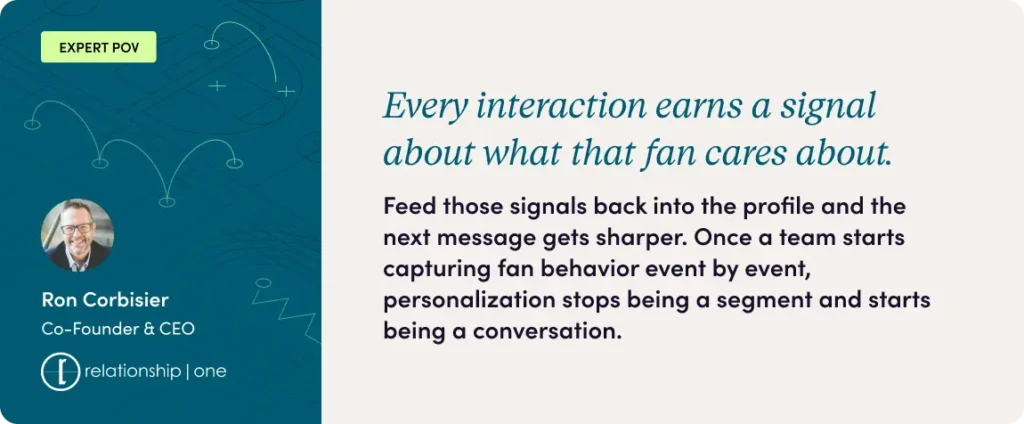
To maintain year-round engagement, leading sports brands look beyond static demographic data, trading exclusive access and content for what fans tell them directly (zero-party data, like a favorite player) and what fans do (first-party data, like games attended). Collecting signals is step one. The value comes from adding each signal to the fan’s profile so the next message reflects what that fan cares about now.
When these signals are aggregated across channels, they transform a static contact record into an active profile intelligence layer. This layer continually scores fan affinity, channel preferences, and purchase propensity, even throughout the off-season.
Yet, turning these signals into real-time engagement requires an engine that can process data instantly, something legacy, batch-based marketing platforms were never built to handle.
The Architecture Shift: The Next-Gen Sports MarTech Stack
Why Yesterday’s Tech Stack Fails
Legacy martech stacks were engineered for the era of scheduled, batch-and-blast email sends. When applied to modern sports marketing, these legacy systems break down across three distinct phases of fan engagement:
- Game-Day Bottlenecks in the Venue: The live game window matters most inside the venue, where excitement and willingness to spend peak together. When legacy batch syncs take hours or run overnight, those opportunities disappear. A seat upgrade, concession offer, or team store promotion tied to a big moment that arrives 20 minutes late misses the moment it was built for.
- Generic Messages Between Games: Beyond the venue, keeping fans engaged across a long season takes cross-channel messages that reflect how the team is playing and what each fan cares about. Batch systems can’t keep pace with shifting schedules, so fans following from home get generic blasts instead of messages tied to the latest game, trade, or favorite player.
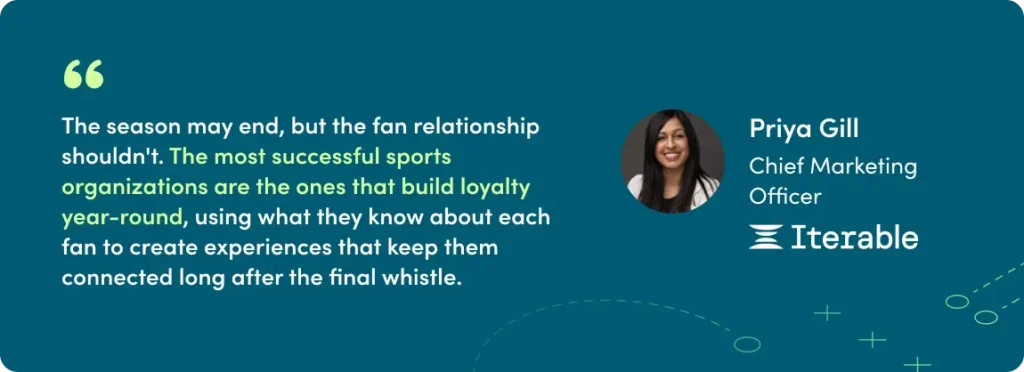
- The Off-Season Lull: Keeping fans warm, app users active, and merchandise selling through months without games is a steep retention challenge. Most legacy stacks rely on static audience segments and scheduled sends, which makes it hard to spot changing fan interests, surface early churn signals, or trigger automated off-season journeys.
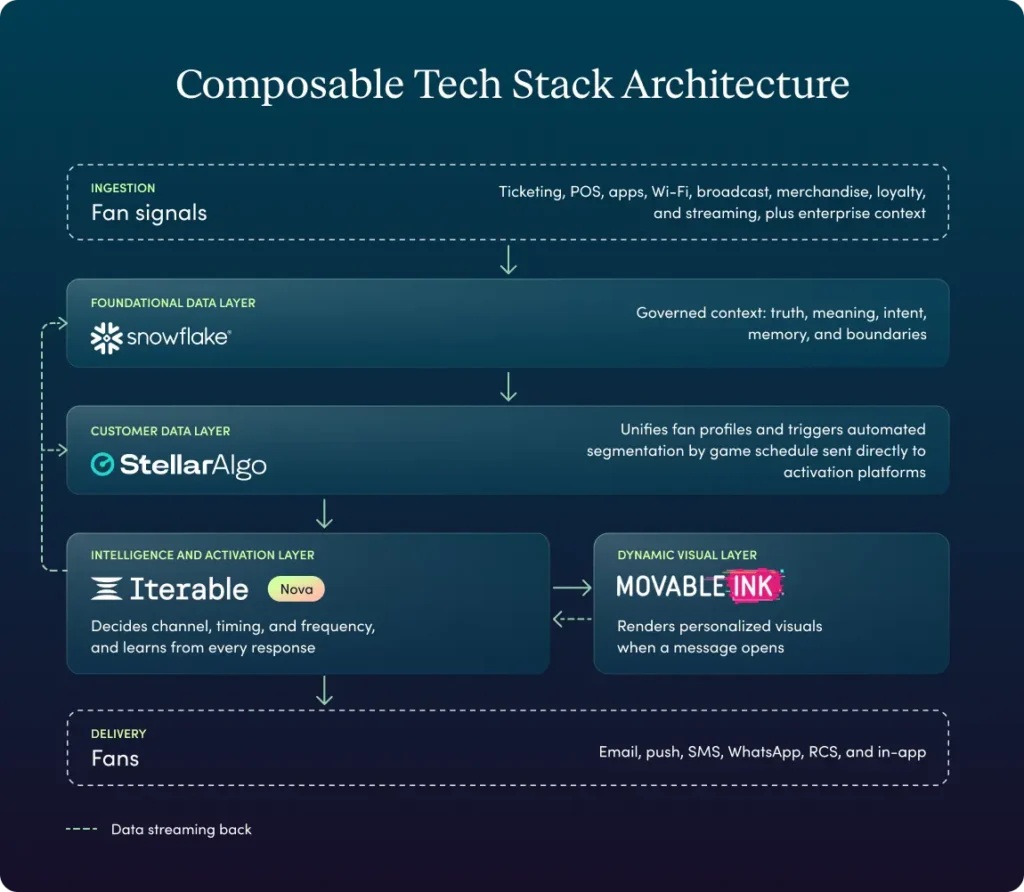
To engage fans all year, teams are moving from one all-in-one system to a set of connected tools that each do one job and share data the moment something happens. This is often called a composable architecture.
Moving away from delayed batch updates allows specialized tools to stream data instantly, capturing fan signals and responding to intent in real time, whether fans are in the venue, between games, or in the off-season.
A Reference Architecture for Year-Round Fan Engagement
While composable stacks can be configured to fit an organization’s unique technical requirements, this playbook features a reference architecture built on specialized, best-of-breed enterprise platforms: Snowflake, StellarAlgo, Iterable, and Movable Ink. Together, they demonstrate how an event-driven engagement engine functions in practice.
In this reference architecture, data moves frictionlessly across each specialized layer:
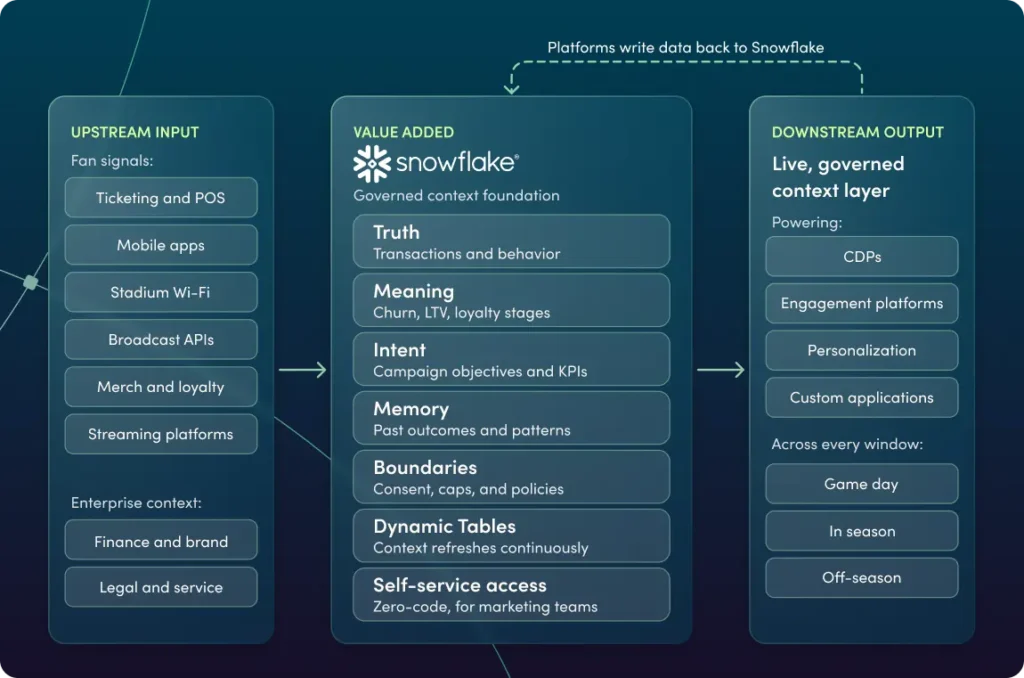
Foundational Data Layer (Snowflake Data Cloud)
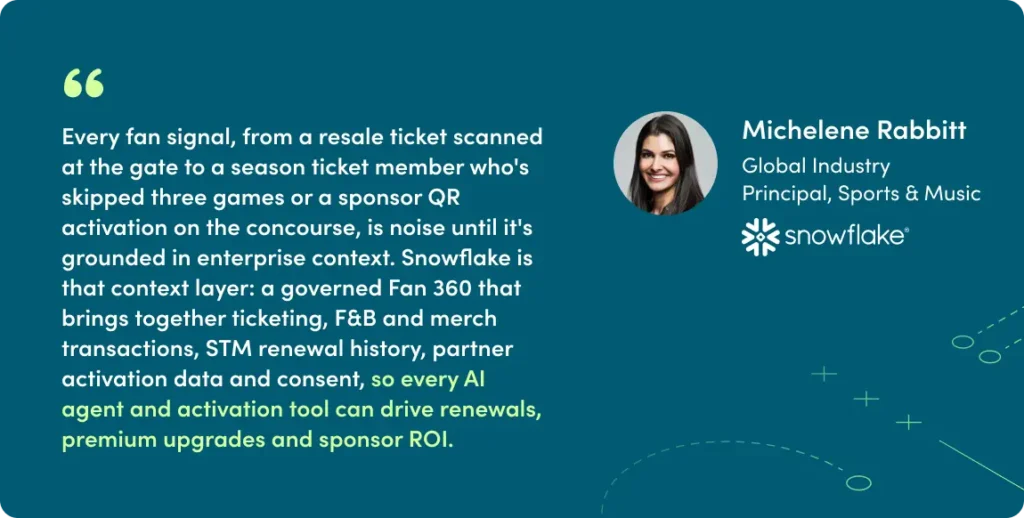
Snowflake serves as the governed enterprise context foundation underlying the entire ecosystem. More than a data warehouse, Snowflake provides every downstream tool (the CDP, the customer engagement platform, and the personalization layer) with the right context to make the right decision at the right moment.
This means going beyond raw fan signals. Snowflake continuously assembles and governs the enterprise context that marketing AI and automation need to act intelligently: fan transaction history and behavioral signals (truth), business definitions like churn thresholds, LTV tiers, and loyalty stages (meaning), campaign objectives and KPIs (intent), historical campaign outcomes and engagement patterns (memory), and consent rules, frequency caps, and brand policies (boundaries). Powered by automated Dynamic Tables, this context refreshes continuously, not on a batch schedule, so it is current whether a fan is in the stadium on game day, browsing player content mid-week during the season, or reacting to a trade rumor in the off-season.
For non-technical CRM and marketing teams, this eliminates reliance on data engineering tickets, manual CSV exports, and stale lists. Marketers gain self-service access to governed, activation-ready context, and every ecosystem partner reads from and writes back to the same foundation, ensuring decisions are coordinated across the entire stack.
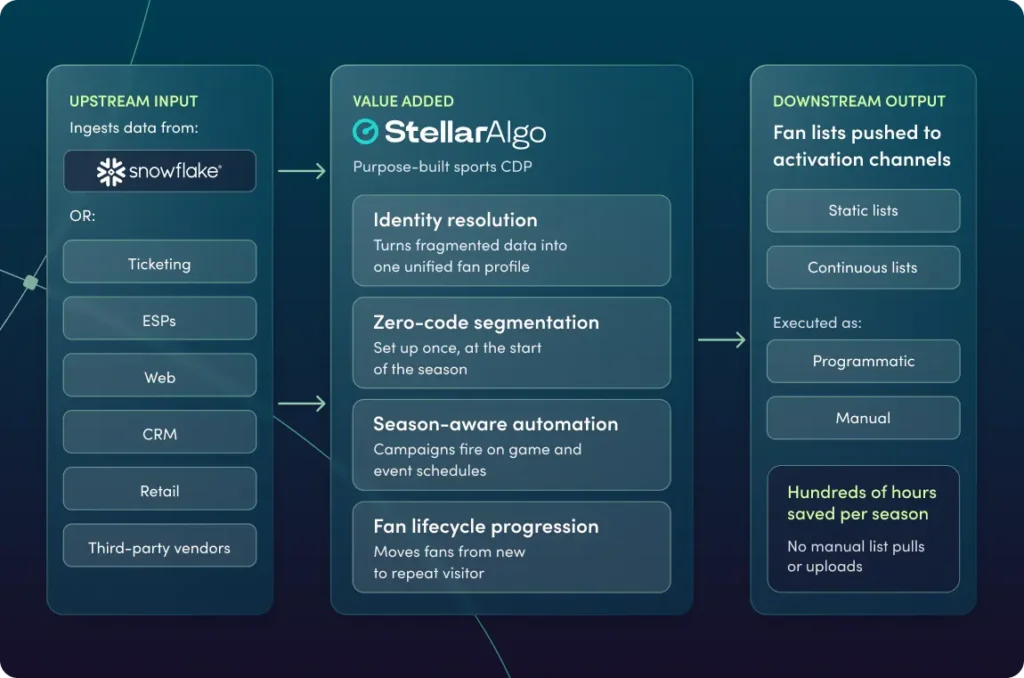
Customer Data Layer (StellarAlgo Sports CDP and Automation Platform)
Sitting directly on top of Snowflake, StellarAlgo is a Customer Data Platform (CDP) and automation platform purpose-built for the unique business models of individual sports teams, leagues, and multi-property live event organizations. StellarAlgo connects directly to Snowflake or ingests disparate data across ticketing, CRM, web, retail, league data feeds, and more to resolve fragmented identities across multi-org ecosystems into unified fan profiles.
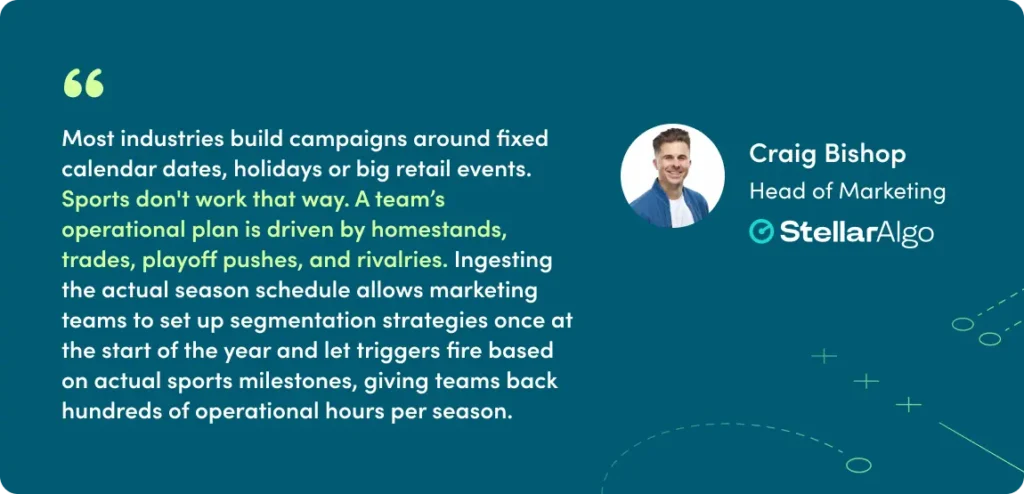
Any given event is an opportunity to capture a new fan, convert a passive viewer into a repeat visitor, and build long-term brand equity. Most sports marketing teams are bogged down building the same repeatable campaigns game after game, making it difficult to capitalize on live, revenue-enhancing opportunities. With StellarAlgo’s automation engine, marketers set up their segmentation strategy once at the start of the season and trigger campaigns to fire based on actual game and event schedules rather than static calendar cycles. Pushing continuous fan lists directly to activation channels eliminates manual list pulling and uploads, unlocking hundreds of hours per season so teams and leagues can focus on optimizing strategy and driving results, as well as enhanced campaign performance by being confident you’re hitting the right fans with the right message.
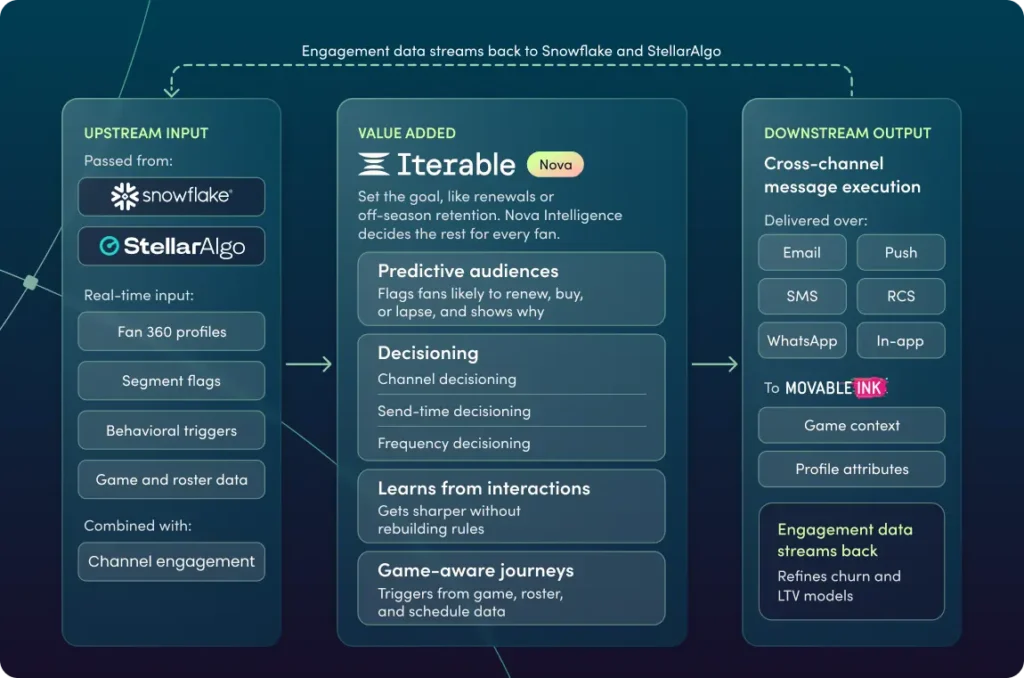
Intelligence and Activation Layer (Iterable)
Once fan data is unified, the next job is acting on it while it still matters. Iterable is the decision layer in this stack: it reads each fan’s live behavior and decides which message to send, on which channel, and when, in season and during the off-season. Powered by Nova Intelligence, Iterable takes in live behavioral signals, player preferences, and audience segments from Snowflake and StellarAlgo, then decides how, when, and where to reach each fan.
Rather than relying on static rules or scheduled batch sends that miss narrow game-day windows or stay quiet during the off-season, Iterable uses Nova Decisioning to choose the channel, timing, and cadence for each fan. Whether coordinating native mobile push notifications during a fourth-quarter comeback, time-sensitive SMS alerts for halftime seat upgrades, in-app draft predictor quizzes, or automated VIP renewal journeys for at-risk season ticket holders, these decisioning models learn from every fan interaction. Combined with triggers from game, roster, and schedule data, journeys respond to what happens on the ice, court, or field without marketers rebuilding them each time.
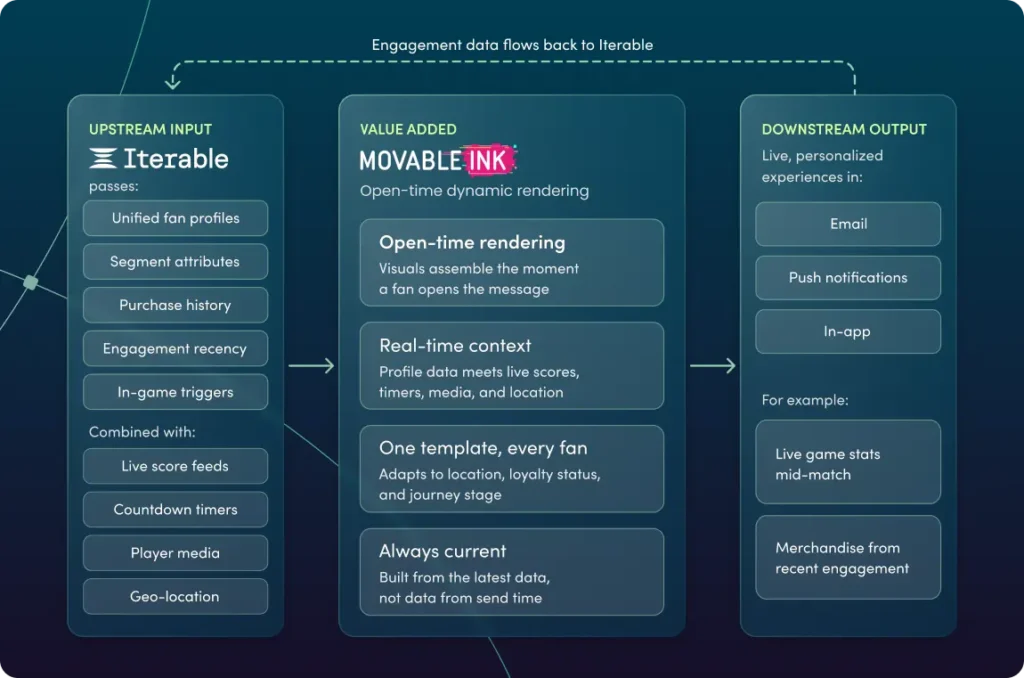
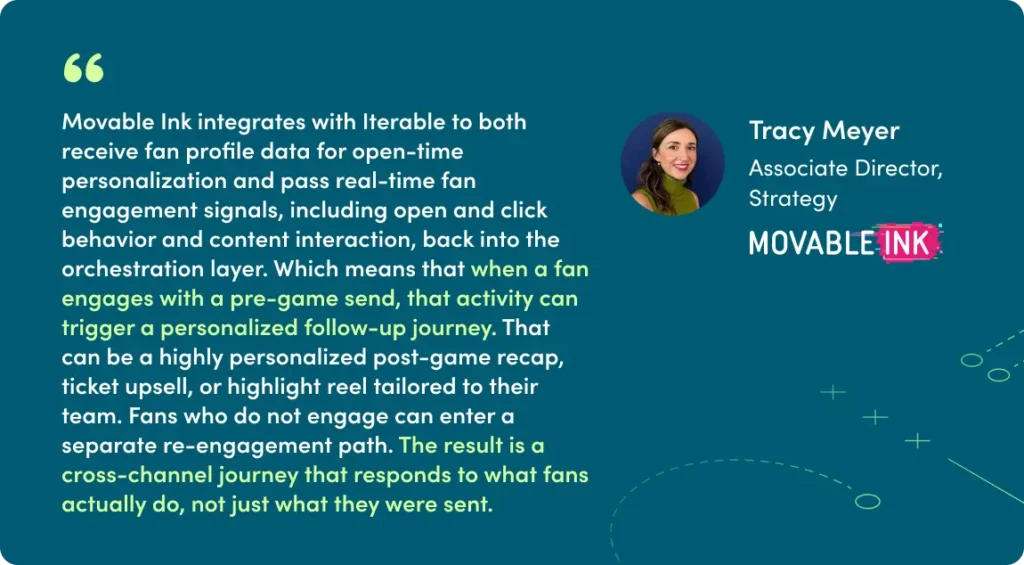
Iterable passes real-time game context and profile attributes to Movable Ink for open-time visual rendering (such as live scores, countdown timers, or multi-year tenure badges) while continuously streaming engagement data back to Snowflake and StellarAlgo to refine predictive AI churn and LTV models.
Dynamic Visual Layer (Movable Ink)
Sports marketers sit on rich fan data, but the time gap between when data updates and when a message reaches the fan means messages often arrive late, feel generic, or are out of date. Movable Ink solves this latency gap by ensuring content is always generated from the most current data available.
By receiving unified fan profile data and behavioral signals passed from Iterable’s orchestration layer, Movable Ink evaluates each fan’s context upon open. The platform combines profile attributes with live score feeds, countdown timers, player media libraries, and geolocation signals to dynamically assemble contextual visual experiences across email, push, and in-app touchpoints.
For marketing teams, this eliminates the tedious process of manually building multiple asset variations for different fan segments. A single, responsive visual template automatically adapts to every fan’s location, loyalty status, and journey stage. This ensures sports organizations maintain an always-on, visually relevant relationship year-round, whether by rendering live game stats mid-match or by showcasing personalized merchandise based on recent engagement.
Game Day Plays: Capturing Real-Time Fan Demand
Game Day Play #1: Draft Unknown Attendees into Known Fans
The Friction Point
Secondary ticket transfers, group bookings, guest WiFi logins, and casual streaming create massive data blind spots, keeping thousands of stadium attendees and digital viewers completely anonymous. Teams spend millions bringing fans into the venue or app, then often walk away without an email address, a favorite player, or permission to stay in touch.
Compounding this anonymity is a simple reality: fans rarely use just one email address. A die-hard fan might buy season tickets with a work email, order official jerseys with a personal email, and fill out a halftime giveaway form with a third address. Without automatic identity matching, marketing teams end up treating one of their biggest fans like three complete strangers.
Tech Stack Orchestration and Cross-Channel Execution
- Enterprise Context Foundation (Snowflake): Snowflake serves as the persistent enterprise context layer that makes anonymous profiles actionable across the entire organization. Every fan attribute, behavioral signal, and lifecycle stage is governed in one place for marketing, sponsorship, finance, ticketing, and executive reporting. Snowflake enriches profiles with cross-domain context such as consent rules, campaign history, churn definitions, and business objectives to ensure downstream execution engines like StellarAlgo and Iterable make decisions with the full operational picture, preventing costly mistakes caused by incomplete context.
- Sports-Domain Identity Resolution and Behavioral Profiling (StellarAlgo): StellarAlgo matches available identifiers such as email, name, or account ID against existing fan records to consolidate interactions into a single profile. By resolving secondary ticket transfers and stitching together multiple email addresses (such as a work email used for tickets and a personal email used for merchandise), the system accurately determines who is holding the seat. These fragmented signals are unified into a single customer view over time, eliminating duplicate lower-value records, identifying high-value superfans, and passing targeting recommendations to the engagement platform based on historical behaviors, such as recognizing fans who consistently attend games against specific rivals.
- Cross-Channel Journey Activation (Iterable): Iterable picks up each newly identified fan and sends an in-app message or SMS during a high-energy moment (such as halftime trivia or a videoboard giveaway) to capture zero-party player preferences and contact permissions. This immediate activation sets the foundation for adaptive, automated engagement that carries the fan relationship across the rest of the season and into the off-season.
Playbook Activation:
Scenario: A guest attending on a transferred ticket enters the stadium, or an existing fan uses a personal email address to log into guest WiFi or scan a videoboard giveaway QR code.
Trigger: The fan submits an in-stadium form fill, scans a venue QR code, logs into Guest WiFi, or accepts a mobile ticket transfer.
Fan Execution:
- In-Stadium Delivery: After submitting their entry details or connecting to the venue WiFi, Iterable evaluates the fan’s profile and sends a push notification or SMS inviting them to select their favorite player. Once they make their selection, the fan receives a personalized digital concession pass powered by Movable Ink, delivered through the same messaging channel. The pass includes an offer, such as 15% off food and beverages, that fans can redeem directly from their phones.
- Post-Game Transition: The fan profile is automatically suppressed from generic single-game ticket sales blasts, and the newly identified fan enters a personalized “Welcome to the Fandom” multi-channel lifecycle sequence. Content dynamically adapts across push, SMS, and in-app channels based on the favorite player selected during entry, building early engagement habits that drive repeat attendance, merchandise sales, and long-term fan lifetime value (LTV).
Game Day Play #2: Win the Concourse and the Couch
The Friction Point
Delivering a single, generic experience during a live game creates severe operational friction and leaves significant revenue on the table. During the game, at-home viewers constantly switch between social feeds, betting apps, and fantasy platforms. Without real-time, synchronized updates such as live scores, interactive polls, or milestone alerts, organizations lose fans’ attention to third-party platforms.
At the same time, context-blind marketing creates immediate frustration. Sending a venue store discount to someone watching from home is useless, while sending a streaming link to a fan sitting in Section 104 feels completely disconnected—driving unsubscribes and app uninstalls over time. Without location awareness, teams miss high-value venue opportunities like halftime seat upgrades, concession line routing, or instant team store passes, and fail to serve at-home fans with the digital offers and e-commerce promotions they are actually primed to buy.
Tech Stack Orchestration and Cross-Channel Execution
- High-Velocity Location Signals (Snowflake): Venue perimeter WiFi sign-ins, mobile app location signals, and gate turnstile scans stream into Snowflake.
- Dynamic Location Segmentation (StellarAlgo): Ingests venue signals and seat assignment data to categorize fans into active In-Stadium versus At-Home / Out-of-Market audience segments.
- Cross-Channel Journey Activation (Iterable): Iterable automatically routes in-venue fans into mobile push, SMS, or in-app paths for venue help, such as their gate and section, plus a team store pass. It then routes at-home viewers into synchronized broadcast and digital merchandise journeys.
Playbook Activation:
Scenario: Fans start arriving at the arena or stadium, or tune in to the pre-game show from home.
Triggers:
- In-Stadium Detection: Turnstile ticket scan entry, stadium perimeter WiFi auto-connect, or mobile app geofence boundary cross.
- At-Home Detection (Default Flow): Pre-game mobile app open, click-through on a pre-game push/email, or broadcast stream tune-in event.
Fan Execution
- In-Stadium Fan: At entry, Iterable sends a push notification that opens an in-app map powered by Movable Ink with directions to their gate section, shortest concession lines, and an exclusive 15% team store venue pass.
- At-Home Fan (Default Flow): If venue presence is not detected upon app open or pre-game engagement, Iterable automatically routes the fan into the at-home engagement flow. Iterable deploys a synchronized “Watch Live” cross-channel journey featuring dynamic broadcast channel listings, one-click stat tracking, and a direct link to pre-order official gear online.
Game Day Play #3: Keep Every Message as Live as the Scoreboard
The Friction Point
Live sports move at high velocity, but traditional marketing creative is static. Sending pre-rendered images and fixed campaign templates during fast-moving game windows creates significant content friction across the entire fan experience. Email and push campaigns sent with static graphics quickly become outdated, such as displaying pre-game standings after the final whistle or advertising an out-of-stock jersey. At the same time, designing, coding, and launching individual creative templates for dozens of teams or 80+ games per season creates massive production bottlenecks and leads to costly human error.
Compounding this creative drag is the simple reality that fans open communications at different times. A static message opened the morning after a dramatic win loses all momentum if it cannot dynamically reflect the final score, highlight reel, or updated player stats. If the content can’t update when the fan opens it, sports organizations can fail to capitalize on peak post-game momentum and leave high-intent impulse revenue on the table.
Tech Stack Orchestration and Cross-Channel Execution
- Data Layer (Snowflake): Game event APIs, live score feeds, player statistics, and behavioral signals stream continuously into Snowflake, maintaining the central, real-time source of truth across the organization.
- Audience Intelligence (StellarAlgo): Ingests event signals from Snowflake, automatically updating target audience criteria (such as first known attendees, season ticket members, high-spending fans) and pushing auto-refreshed segment lists directly to Iterable at the desired cadence.
- Cross-Channel Journey Activation (Iterable): Live game events reach Iterable directly through its API, while StellarAlgo keeps the audiences current. Channel Decisioning picks each fan’s preferred channel (SMS, push, or email), and Iterable sends within seconds of the moment.
- Visual Personalization (Movable Ink): Assembles dynamic creative modules at the time of open by pulling live scores via APIs. Simultaneously, Movable Ink captures open-time environmental signals (device type, location, exact open timestamp) and streams click engagement data back into Iterable to dynamically pivot downstream journey paths.
Playbook Activation:
Scenario: A live game finishes, a player records a key stat milestone, or a fan opens a team newsletter hours after the broadcast.
Triggers:
- Event Trigger: Live sports stat APIs, score feeds, or RSS feeds transmit milestone events.
- Open-Time Trigger: Fan open or click actions trigger dynamic asset assembly at the exact moment of open.
Fan Execution
- Pre-Game vs. Post-Game Recipient: Opening a game-day email two hours before puck drop shows a countdown timer and arena details. Opening the same email ten minutes after the final horn shows the final score, the three stars of the game, and team highlights.
- Post-Game Buyer: Opening a post-win push notification or email renders a dynamic graphic featuring the star player of the game alongside direct links to purchase their specific jersey, with inventory levels updating in real time.
Case Study: NHL “The Wraparound” Newsletter
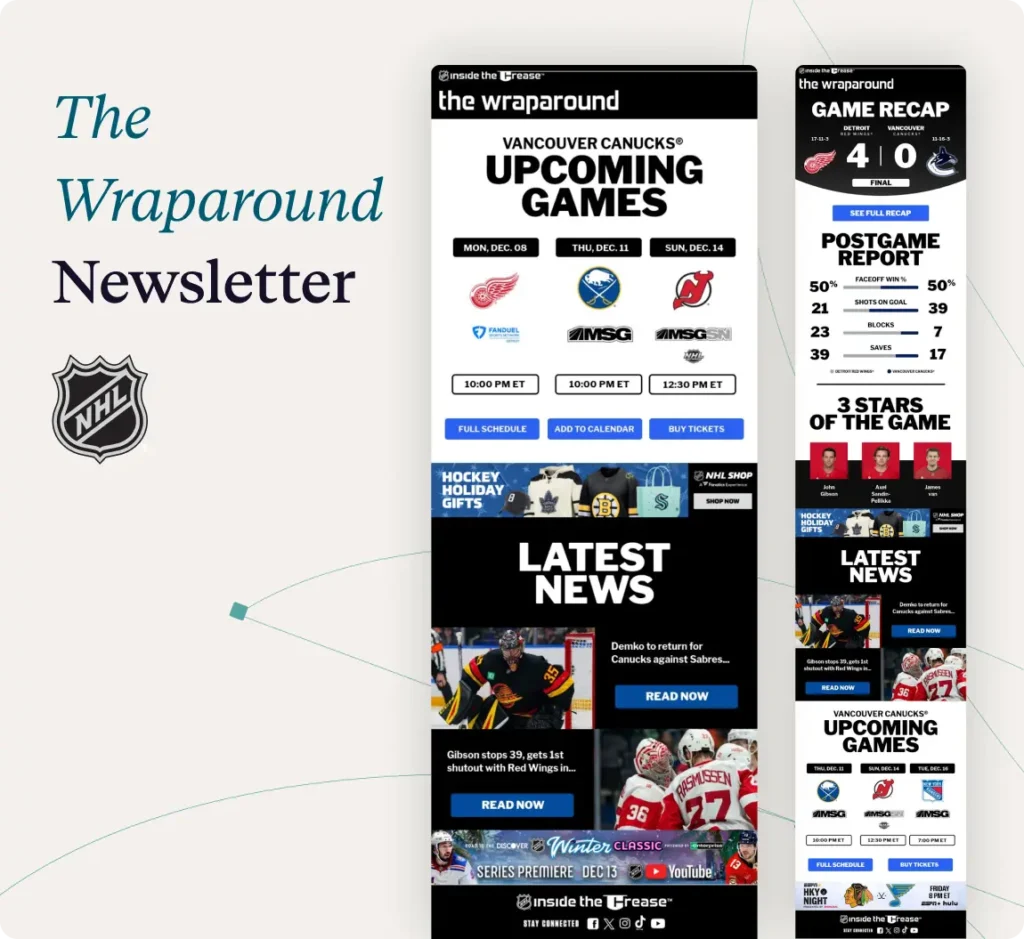
Instead of building multiple manual versions, the NHL connects live APIs, CSVs, RSS feeds, and Iterable signals to dynamic Movable Ink modules. When a fan opens The Wraparound, the content updates at open time to show the final score, “3 Stars of the Game”, upcoming game times, and latest news.
- 33 Teams, 1 Build: Powers 33 team-specific versions of the newsletter from a single campaign build, automatically updating scores, standings, and player stats
- Moment-of-Open Context: Displays countdown timers for pre-game sends and real-time score recaps post-game, ensuring relevance whether opened at the final buzzer or the next morning.
Watch the On-Demand NHL Webinar to learn more
Game Day Play #4: Capitalize on In-Game Momentum with Database Machine Learning and Merchandising
The Friction Point
Broad, segment-based marketing blasts generic merchandise offers and uniform ticket packages to fans, leaving significant game-day revenue on the table. When a fan attends a high-stakes match or engages with post-game coverage, their purchase intent peaks within a narrow, high-urgency window. Failing to capture this immediate momentum leads to lost sales and low conversion rates.
Additionally, traditional machine learning models require exporting sensitive fan data out of the central database into third-party tools, creating severe data security risks, high pipeline engineering overhead, and stale recommendations by the time messages are delivered.
Tech Stack Orchestration and Cross-Channel Execution
- In-Database Intelligence (Snowflake): Snowflake Cortex ML calculates 1:1 merchandise, content, and ticket propensity scores natively within the governed data foundation, with zero data movement to third-party tools. Because Cortex ML operates on the full enterprise context, recommendations reflect not just purchase history but cross-season engagement patterns, loyalty stage, and current business objectives like margin targets or inventory priorities.
- Direct Activation and Journey Decisioning (Iterable): Recommendation flags pass directly from Snowflake to Iterable. Iterable evaluates fan context to dynamically route individual recommendation offers through email, SMS, mobile push, or in-app channels while game-day intent is at its peak.
- Moment-of-Open Visual Rendering (Movable Ink): Assembles personalized visual product modules at open time, automatically reflecting live store inventory, localized sizing, or exact seat inventory
Playbook Activation:
Scenario: A fan attends a game or browses live team coverage following a marquee win or player record, demonstrating high engagement with a particular player.
Trigger: Snowflake Cortex ML generates a high-propensity recommendation flag for the purchase of that specific player jersey in a retro style, updating the fan profile in real time.
Fan Execution:
- In-The-Moment Fan Experience: Moments after the game ends, the fan receives a push notification while post-game excitement is high.
- Seamless Visual Merchandising: Upon opening the message, the fan sees a dynamic visual banner showcasing the exact retro jersey of the game’s standout player, in their size, with live team store inventory and a one-click checkout link.
Game Day Play #5: Run Campaigns on Game Time, Not Calendar Time
The Friction Point
Most consumer industries build marketing plans around fixed calendar dates like holidays or annual retail events, but sports organizations run on fluid, dynamic team schedules. Managing campaigns across changing game times, multi-game homestands, playoff shifts, trade windows, and draft dates creates massive operational complexity for lifecycle teams.
Marketing teams spend hundreds of hours manually pulling, verifying, and updating static segment lists every time a game time shifts, a TV broadcast updates, or a team advances in the postseason. Treating every campaign as an isolated date-based send makes it impossible to orchestrate personalized journeys aligned with a team’s true operational rhythm. This disconnect leads to mis-timed messages, confused fans, and lost ticket and merchandise revenue during critical season moments.
Tech Stack Orchestration and Cross-Channel Execution
- Season-Aware Automation (StellarAlgo): StellarAlgo ingests official team and league schedule feeds to continuously evaluate game dates, and automatically sends segments to activation channels at the pre-determined trigger, whether that’s tied to a calendar date or season activity (ie. 3 hours pre-game, 12 hours post-game).
- Pre-Set Journey Orchestration (Iterable): Marketers create adaptive, cross-channel lifecycle journeys inside Iterable at the start of the season. Iterable automatically ingests updated segment entry signals from StellarAlgo as team schedules shift, eliminating manual campaign setups and delayed sends while ensuring messages land when fans are most engaged.
Playbook Activation:
Scenario: A team’s game schedule changes, a playoff series is clinched, or a key season milestone occurs.
Triggers:
- Schedule Changes: Official league stat feed or ticket API updates a game time or date.
- Automatic Rescheduling: StellarAlgo’s season-aware engine detects a schedule change. Scheduled segments now fire according to the rescheduled game, with no manual intervention needed.
Fan Execution:
- Homestand Season Ticket Holder: Automatically enters a pre-set, dynamic pre-homestand journey inside Iterable 48 hours before a multi-game home stretch. Content dynamically renders personalized ticket management options, seat upgrade passes, and stadium perk reminders generated at open time by Movable Ink.
- Single-Game Ticket Prospect: Automatically enrolled into a pre-built rivalry journey via Iterable the moment a key game time is finalized. Channel Decisioning selects SMS for this fan, and Iterable sends a one-click link to secure remaining seat inventory before tickets are released to the general public.
The Off-Season Plays: Sustaining Year-Round Fan Loyalty
The Friction Point
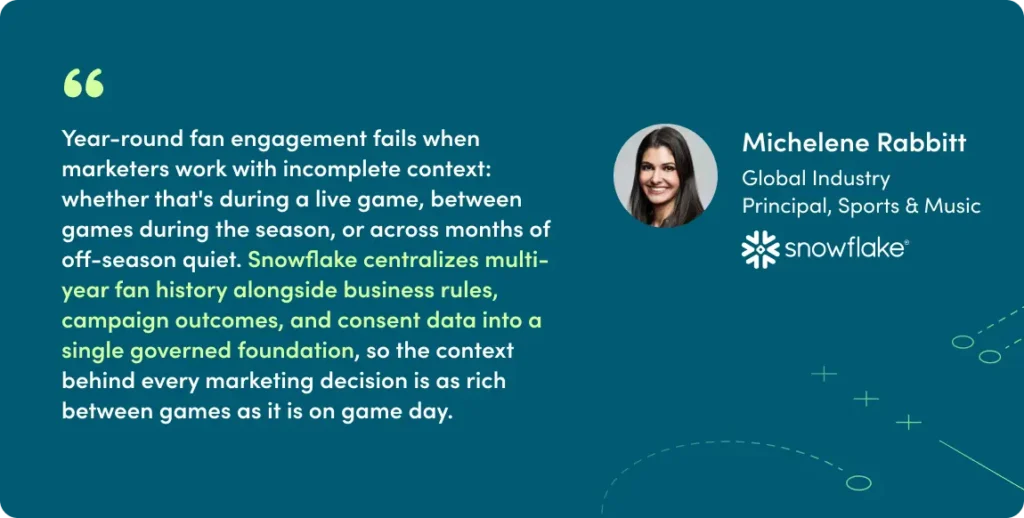
When game updates stop, mobile app sessions drop, and teams pay to win those users back the next season. Meanwhile, the richest personalization signals (buried across years of ticketing transactions, retail purchases, app interactions, and stadium visits) remain trapped in disconnected data silos.
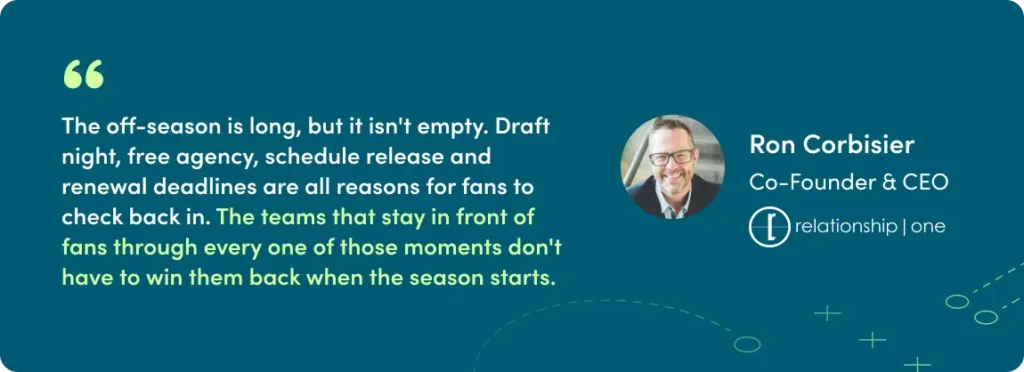
This operational disconnect causes severe revenue leakage during quiet windows. Unengaged season ticket holders quietly drift away until their disengagement manifests as an unexpected, costly non-renewal. At the same time, blasting generic merchandise emails or broad ticket announcements during the off-season drives unsubscribes and app uninstalls. Marquee off-season milestones such as draft night, schedule release day, trade deadlines, and jersey reveals are frequently treated as static, one-off email blasts rather than interactive, multi-channel journeys that build lasting fandom.
Tech Stack Orchestration and Cross-Channel Execution
- Enterprise Context and Predictive Intelligence (Snowflake): Snowflake centralizes multi-year ticketing history, retail transactions, streaming activity, content engagement, and loyalty interactions, enriched with enterprise context such as churn definitions, renewal timelines, and campaign performance history. Automated Dynamic Tables continuously transform this foundation into activation-ready models including churn risk scores, content affinity signals, and lifecycle stage indicators that power year-round engagement across game day, between games, and off-season retention.
- Schedule-Aware Audience Intelligence (StellarAlgo): Rather than relying on generic calendar months, StellarAlgo ingests team schedules and key off-season milestones like draft day and schedule release. Teams can then build their segmentation strategy in advance of the season, add inclusion and exclusion rules, and be confident their segments will be automatically pushed directly to the desired activation channels at their set cadences, without requiring manual pulls.
- Cross-Channel Journey Activation (Iterable): Serving as the central engagement decision engine, Iterable ingests predictive churn risk scores from Snowflake and schedule triggers from StellarAlgo. Iterable automatically routes fans into tailored lifecycle paths, shifting away from generic batch-and-blast emails toward adaptive cross-channel journeys across email, SMS, mobile push, and in-app channels.
- Moment-of-Open Visual Personalization (Movable Ink): Assembles visual assets, populating personalized perk modules, interactive voting polls, live countdown timers, and “Add to Calendar” links. Every interaction passes directly through Iterable back into Snowflake and StellarAlgo to continuously enrich data sources.
Off-Season Play #6: Defend Your Season Ticket Base with Predictive Churn Scores
Scenario: A long-time season ticket holder shows declining digital engagement (fewer mobile app opens, zero email clicks) 90 days prior to the annual account renewal deadline.
Triggers: Snowflake’s predictive churn model or StellarAlgo’s engagement scoring detects a sharp drop in account utilization and updates the fan’s risk profile.
Fan Execution: Iterable picks up the churn risk score from Snowflake or StellarAlgo and holds this fan out of generic renewal promotions. The fan enters a tailored re-engagement journey featuring a personal video message from the team’s general manager and a Movable Ink open-time module offering early-access passes to an exclusive off-season Q&A. If the email goes unopened after a few days, the journey follows up with a personalized SMS for fans who’ve opted in.
Off-Season Play #7: Lock In Early Renewals with VIP Milestone Celebrations
Scenario: An active season ticket holder or superfan reaches a significant loyalty milestone or completes a high-engagement season during the off-season.
Triggers: StellarAlgo’s engagement scoring identifies high account utilization, or Snowflake’s historical data pipeline passes a milestone badge event (such as 10-year tenure or attending 15+ home wins) directly to Iterable.
Fan Execution: The fan enters an Iterable renewal journey that highlights their personal season milestones such as total games attended and favorite team wins. Iterable leverages Send Time Decisioning to trigger personalized SMS updates and dynamic Movable Ink renewal perks at the exact moment when each fan is most likely to engage, driving early renewal commitments.
Off-Season Play #8: Rally Fans Around Marquee Off-Season Moments
Scenario: A major off-season milestone occurs, such as schedule release day, the draft, a key player acquisition, or a throwback jersey reveal.
Triggers: StellarAlgo’s season-aware engine detects the milestone event and automatically passes dynamic audience triggers directly to Iterable.
Fan Execution:
- Loyal Draft-Day Content: On draft night, fans categorized in high-affinity app-user segments from Snowflake or StellarAlgo automatically receive a mobile push notification granting exclusive access to behind-the-scenes footage from the practice facility and draft room.
- Schedule-Release Ticket Prospect: The fan receives a personalized Iterable email with a Movable Ink “Add to Calendar” module built around their favorite team’s matchups. Clicking a preferred rivalry game automatically captures zero-party intent, prompting Iterable to send an exclusive pre-sale ticket link by push notification before tickets open to the general public.
Off-Season Play #9: Score Long-Term Fans with Preference-Driven Nurtures
Scenario: Midway through the off-season, a fan interacts with digital touchpoints, behind-the-scenes practice footage, community co-creation polls, or early priority sign-up forms before schedules or tickets are available.
Triggers: A fan watches exclusive facility clips, votes in a throwback jersey poll, or completes a schedule priority pass request form.
Fan Execution:
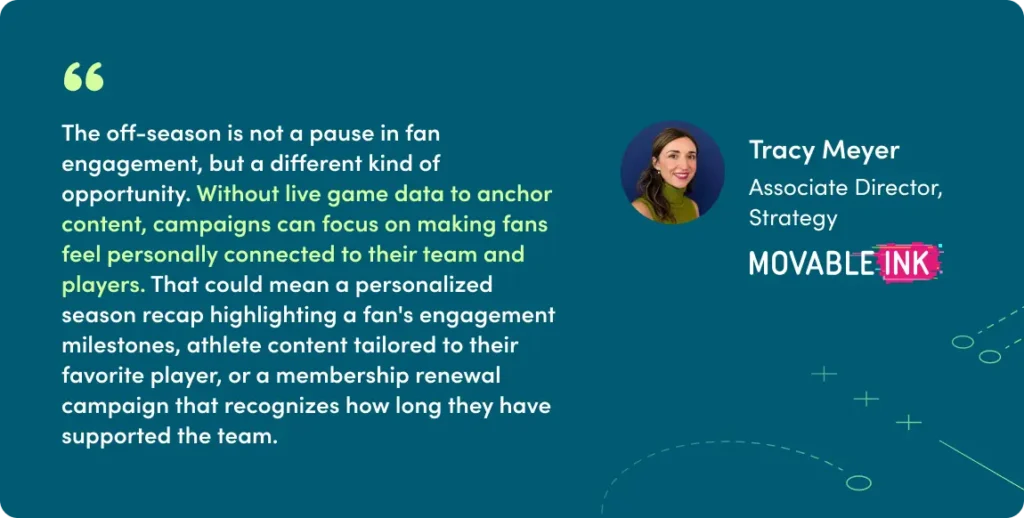
- Athlete & Content Affinity Cohort: On their phone during the quiet off-season, a fan opens a team notification and watches an exclusive, behind-the-scenes locker room tour. While watching, an interactive Movable Ink module prompts them to tap their favorite player or vote on next season’s throwback jersey concept. Tapping their choice instantly registers their zero-party preference, automatically tagging their profile with an explicit “Favorite Player” attribute. Downstream, the fan experiences a completely customized feed: every subsequent email, SMS, and in-app message highlights content, video clips, and exclusive apparel drops featuring that specific athlete.
- Priority Schedule and Ticket Prospect Cohort: While browsing off-season team content, a fan signs up for priority notification of the schedule release and picks how they want to hear about it. That signal lands on their Iterable profile and flows to StellarAlgo, which moves them into a high-priority ticket prospect segment. When the official league schedule drops, Iterable launches the ticket journey on the channel the fan chose – timed by Send Time Decisioning for email and push – with a Movable Ink schedule preview and a one-click link to secure single-game tickets before public release
Case Study: Melbourne Football Club Transforms Year-Round Member Activation
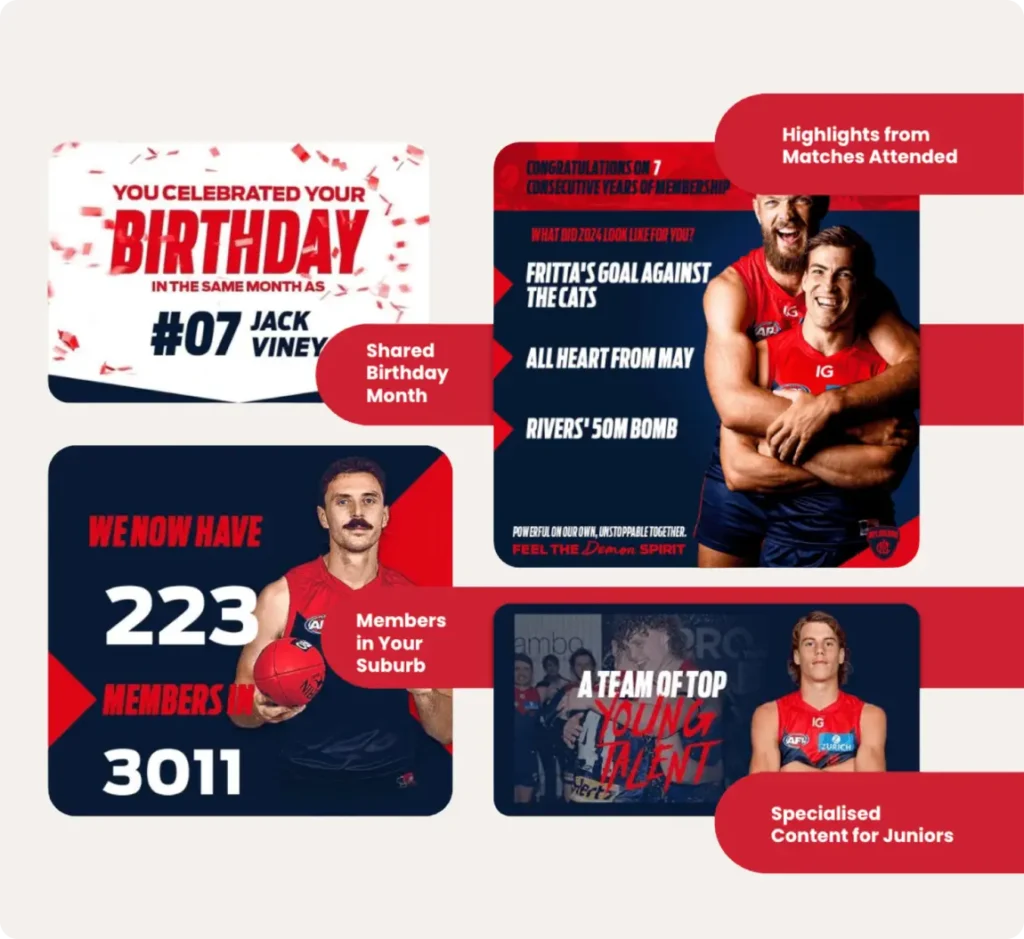
Melbourne Football Club put this off-season playbook into practice with an end-of-season campaign designed to deepen member connection. The club brought member data from Snowflake into Iterable and used Movable Ink to build an end-of-year wrap-up unique to each member: how many members live in their postcode, which player shares their birthday month, and highlights from the games they attended. The campaign drove 756 net-new memberships, with conversion rates significantly higher than previous campaigns.
Navigating the Modernization Shift
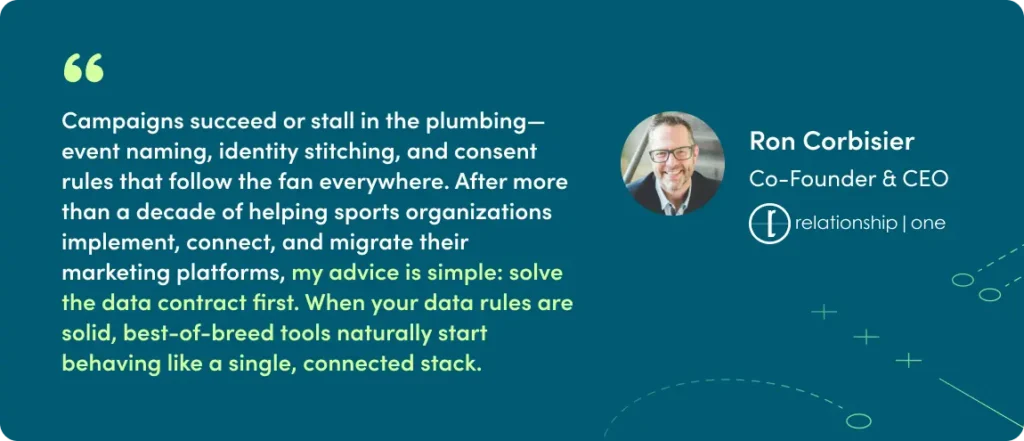
Picking the tools is the easy part. Most projects succeed or stall on data operations. While high-level architecture diagrams make composable systems look simple on paper, execution succeeds or fails in the foundational alignment between data governance and real-time activation. Standardizing event schemas, resolving fan identities across platforms, and enforcing consent rules at ingestion are critical to eliminating technical drag.
Tech Stack Audit and Implementation Checklist
To evaluate whether your technology infrastructure and operating model are truly game-day ready, audit your stack against these core execution principles from Relationship One:
- Time Big Moments End to End: Select three critical game-day triggers (such as the final whistle, a player milestone, or a halftime seat upgrade release) and time how long it takes from the moment it happens to the message landing on a fan’s phone. Any step that runs on a batch schedule sets your speed limit.
- Turn Anonymous Visitors into Known Fans: Ticket transfer recipients, group buyers, guest WiFi users, and app browsers who never log in are some of your biggest blind spots. Give fans a clear reason to identify themselves, like claiming a digital ticket, getting on WiFi, or entering an in-app contest. Then agree on one fan ID across ticketing, CRM, commerce, and the app, with written rules for which record wins when two merge.
- Ensure Consent Travels With the Fan: Opt-ins captured at the gate, in the app, or through a ticketing partner should reach your customer engagement platform within minutes, with the source attached, so every system agrees on who can be contacted and on which channel.
- Watch Renewal Risk All Season: Track scan rates, resale and transfer activity, and app opens for every plan holder. When they drop, trigger a check-in from their rep or a member-only offer long before the renewal notice goes out.
- Build Off-Season Journeys Before the Season Ends: Have post-season thank-you flows, churn-risk paths for quiet ticket holders, and triggers for the draft, schedule release, and renewal dates built before the final game, and turn them on the day after it.
- Close the Loop: Send customer engagement data back to your warehouse and to your ticket reps, so sales sees which fans are warming up and analytics can tie messages to revenue.
- Name an Owner for Every System: For each platform in the stack, write down who owns the data, who can change a trigger, and who gets the call if an integration fails during a live game or late on a weekend.
- Start with Two: Begin with one game-day trigger and one renewal signal. Get them working, track the results for a few weeks, then layer in the next journey.
Conclusion: Turning Fleeting Moments into Lifelong Fandom
Winning the modern fan relationship requires bridging the gap between fleeting game-day emotion and predictable, year-round revenue. Teams get there by moving from batch operations to connected tools that share data as events happen, so they can act on game-day moments in seconds, identify the fans they’re missing, and keep each fan engaged after the season ends.
A good place to start: pick your three biggest game-day moments and time them end to end this season, and build your off-season journeys before the final game.
Talk with Iterable about mapping one game-day or off-season moment for your team.