
Campaign calendars once promised control: seasonal drops, quarterly launches, predictable plans. That playbook is finished, because the truth is that customers don’t live by your deadlines. They live in a constant stream of choices, expecting relevance in the exact moment they act.
CMOs see it every day: dashboards overflowing with noise, pressure to deliver more with fewer resources, and a marketplace where irrelevance is one bad send away. This comes straight from the customers, 65% of whom say targeted messaging is the reason they buy.
This is where AI agents come in — intelligent features that act on behalf of the marketer to keep engagement relevant in real time. By handling tasks like suppression, scheduling, and optimization, agents make moments-based marketing achievable at scale.
Here are the five steps that separate the future from the past.
Step 1: Build Your Data Foundation for Intelligent Marketing
Marketers are drowning in data and starving for insight. Oceans of customer signals sit idle, trapped in systems that don’t talk to each other. The result is missed revenue and wasted potential. It’s no surprise that 66% of marketers at Activate Summit 2025 call their data management “messy” or “inconsistent.” Only 4% claim strong data hygiene. Another 9% don’t even know enough about their data to answer basic questions. That’s not a gap. It’s a liability.
Common Data Challenges |
What You Need To Succeed |
|
Scattered systems: Signals are locked in disconnected tools and departments, making a complete customer view impossible. |
A live understanding of the customer: Unify identity, behavior, and intent data with external context — pricing, inventory, even weather — and layer in business priorities like promotions or services to create one source of truth. |
|
Tickets and bottlenecks: Marketers wait on engineering or dashboards while customer moments slip away. |
Real-time flexibility: Use cloud-native, API-first architecture that scales instantly as customer signals change. |
|
AI without fuel: Teams are told to be “AI-ready,” but machine learning is useless without clean, reliable data. |
Self-serve access: Give marketers direct access to the data they need, cutting out bottlenecks and backlogs so action happens in the moment. Iterable’s Responsive Activation agent ensures those signals don’t just sit in dashboards — they trigger actions the instant customer behavior changes. |
Think of it like cooking. Some ingredients come from the pantry, some from the local store, and others from a specialty shop. The recipe only works if everything is fresh, consistent, and ready when you are. Stale or missing ingredients mean the dish fails.
Data works the same way: Unified, accurate inputs make marketing reliable, while fragmented or outdated data spoils the outcome before it even reaches the table.
| Joybird reduced reliance on tech resources by 93% by activating data through Iterable. |
Step 2: Redesign Your Journeys for Real-Time Relevance
Once data is unified, the next step is to design journeys that move at customer speed. Static, funnel-based flows planned months in advance are relics. They struggle to keep up with shifting signals and fail to deliver relevance when it matters most.
The barriers are clear when you talk to marketers:
- 33% marketers blame fragmented data — signals scattered across disconnected systems that make real-time action impossible.
- 20% point to a lack of technical resources, forcing them to rely on overburdened engineering teams.
- 18% say they’re simply under-resourced, stretched too thin to execute personalization at scale.
- 7% cite silos that slow collaboration and stall insights.
Different numbers, same conclusion: Today’s structures weren’t built for the speed and adaptability moments-based marketing demands.
Common Journey Challenges |
What You Need To Succeed |
|
Rigidity: Most journeys are designed months in advance, locked into funnel logic, and fail to pivot when customer needs change. |
Proactive intelligence: Predictive goals flag weak points before performance collapses. Iterable’s Customer Journey Agent helps marketers see when flows are drifting off-course and recommends adjustments, so journeys adapt in real time instead of getting stuck in static funnels. |
|
Consumer burnout: Brand-first funnels repeat themselves until audiences tune out. |
Experimentation at scale: Built-in testing and AI-powered writing agents keep messaging, creative, and timing fresh and relevant. |
|
Misalignment: Editorial, growth, and regional teams operate in silos, delaying the exchange of insights. |
Collaboration in one environment: Shared workspaces and built-in notes keep every function — editorial, growth, regional — moving in sync. |
Designing customer journeys is like hosting a dinner party. Plans rarely go exactly as expected, as guests show up late, seating shifts, and surprise plus-ones walk through the door. A great host doesn’t cling to the original plan; they adapt in the moment so everyone feels welcome.
Journeys should work the same way: flexible and responsive, adjusting in real time to every customer signal.
| Madison Reed saw a 45% lift in subscription upgrades with dynamic journeys. |
Step 3: Scale Contextual Personalization With Modular Content
Once journeys can adapt dynamically, the next challenge is making sure the content inside them can flex just as easily. Even the most sophisticated journey fails if what fills it feels stale, generic, or irrelevant to the moment.
Common Personalization Challenges |
What You Need To Succeed |
|
Static templates: Quarterly-built, hard-coded content leaves no room to flex with shifting signals. |
Modular building blocks: Flexible snippets, blocks, and templates that assemble into endless variations in minutes. Iterable Studio turns one idea into limitless content without scaling effort. |
|
Context ignored: Messages miss cues like behavior, timing, or emotion — customers tune out fast. |
Context alignment: Match what the customer is doing (browsing, buying, hesitating) with what the business needs to highlight: product catalogs, promotions, and seasonality. |
|
No feedback loop: Performance data isn’t fed back into the system, so mistakes repeat and opportunities are lost. |
Iterative learning: Every campaign should inform the next. A holiday shopper who buys kids’ clothes should be first in line for back-to-school offers. With Iterable’s Writing Agent, marketers can quickly generate fresh variations of copy and creative. |
If Step 1 was about gathering ingredients, modular content is about refining the recipe for the guest and occasion. The pantry gives you options, but the real magic comes from adapting to the moment. Serve the right dish, in the right way, and evolve with every meal.
| A+E Networks increased monthly sends by 50% while cutting production time by 75%. |
Step 4: Put AI To Work With Human-Led Expertise
With adaptive journeys and modular content in place, the next step is acceleration. But speed without intelligence isn’t progress. It’s chaos. Marketers are under pressure to adopt AI, yet many don’t know where to begin or how to integrate it responsibly.
Common AI Challenges |
What You Need To Succeed |
|
Unclear adoption path: AI feels abstract. Teams hear the hype but don’t see a roadmap to practical adoption. Many tools overpromise but deliver black-box outputs that are hard to explain and even harder to scale responsibly. |
Built-in best practices: Iterable Nova orchestrates multiple agents — from Governance Agents that suppress fatigue, to Scheduling Agents that find the right moment to send, to Delivery Agents that route messages through the optimal channel. Together, they embed best practices directly into workflows, ensuring consistency, governance, and transparency — never bolted on as an afterthought. |
|
Fear of replacement: Teams worry AI will replace creative or strategic work instead of amplifying it. |
Human-in-the-loop orchestration: Marketers set the why and the what. AI accelerates the how and when, with explainability baked in. |
|
Missed moments: Without embedded intelligence, no human team can keep pace with every customer signal in real time. That means missed opportunities. |
Continuous learning: AI should surface alerts, recommendations, and insights that humans might miss — and then get smarter with every outcome. |
Think of AI as your sous-chef. It preps ingredients, tracks supplies, and suggests variations to keep the kitchen moving. But the chef (or the marketer) still defines the dish, sets the intent, and makes the final call. AI brings precision and speed; humans bring vision and taste.
| Redfin saw a 72% increase in active users with Predictive Goals. |
Step 5: Turn Strategy Into Revenue-Critical Action
Unified data, adaptive journeys, modular content, and AI are all irrelevant if the strategy never reaches the customer. Big ideas stall in decks, get stuck in approvals, or are buried in silos too often.
Here, agents evolve into something more powerful: agentic intelligence. Instead of just automating tasks, the system itself senses signals, makes decisions, and takes action to achieve your goals — closing the loop from strategy to execution.
Common Execution Challenges |
What You Need To Succeed |
|
Backlog bottlenecks: Campaigns get delayed by approvals, tickets, or resourcing bottlenecks. |
Align to business outcomes: Anchor goals to revenue impact (conversions, renewals, upgrades, churn prevention), not vanity metrics like opens and clicks. |
|
Execution gaps: Teams set goals but never translate them into real customer outcomes. |
Close the activation gap: Use AI to optimize in real time. Iterable Nova can flag underperforming segments and suggest pivots while campaigns are still live. |
|
Elevate marketing ops: Shift ops from gatekeeping to growth enablement. Guardrails like frequency caps and brand governance let marketers move fast without losing control. It’s even better if you partner with professional services or agencies to extend bandwidth and strategic guidance. |
Even the best recipe doesn’t matter if the meal never leaves the kitchen. Execution is the line in a restaurant: prep, plating, and serving must all happen in sync. Strategy is only valuable when it’s delivered hot, on time, and to the customer who ordered it.
| ClickUp increased net dollar retention by 9% within five months of switching to Iterable. |
Mapping to the Moment
Teams stuck in outdated models struggle with rigid campaign calendars, fragmented tools, and slow feedback loops. Static campaigns are locked in months ahead, leaving no room to flex when customer needs shift. Manual processes grind execution to a halt, and by the time insights arrive, they’re already stale. The result is wasted effort, disengaged audiences, and missed opportunities to connect in the moment.
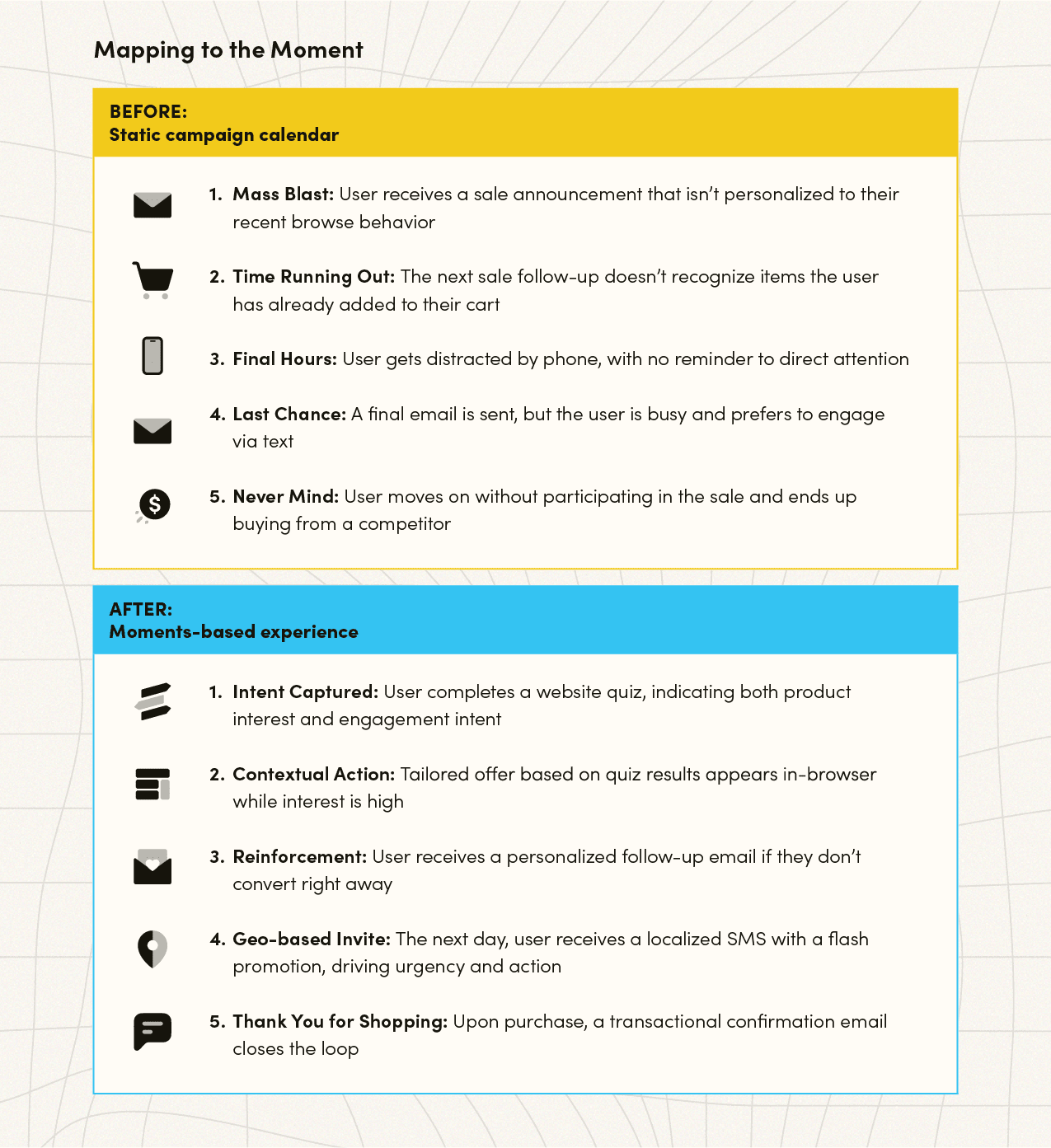
Adopting these five steps flips the script. Marketing becomes intelligent and driven by customer needs, not brand timelines. AI agents handle the details — routing messages, optimizing channels, and scaling content — while marketers focus on strategy. With Nova connecting them into a system of agentic intelligence, marketing shifts from chasing growth to designing it, moment by moment.
Evolve Beyond Campaign Calendars
The era of incremental tweaks is finished. Customers expect relevance in every interaction, and rigid campaign calendars are too slow to deliver it. Moments-based marketing equips brands with the intelligence, flexibility, and speed to meet customers where they are and transform fleeting signals into lasting loyalty.
| It’s time to move beyond outdated tactics. Download The New Era of Moments-Based Marketing: 5 Steps to Evolve Your Marketing Maturity to see how leading brands are eliminating outdated tactics and building customer loyalty that lasts. |