
Artificial intelligence isn’t just another technology shift. It’s a performance multiplier. And in marketing, that multiplier is making one thing increasingly clear: the gap between high performers and everyone else is widening.
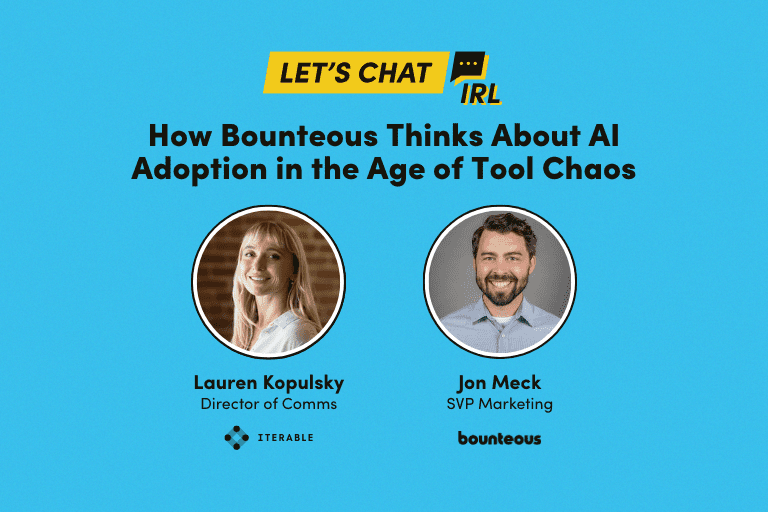
In a recent Let’s Chat IRL conversation, Jon Meck, SVP of Marketing at Bounteous, shared a perspective that reflects what many leaders are seeing across the industry. AI isn’t replacing marketing teams. It’s reshaping how the best teams operate—and exposing where others are falling behind.
Here’s what that means for modern marketing organizations.
AI Is an Amplifier, Not a Shortcut
AI has quickly become embedded into nearly every tool marketers use—email platforms, design software, analytics dashboards, content systems, and collaboration suites. But simply having access to AI isn’t the differentiator.
The differentiator is depth of use.
High-performing marketers aren’t using AI as a novelty. They’re using it to brainstorm faster, test more concepts, build prototypes quickly, refine targeting, optimize timing, and interpret performance data in real time. They treat AI as an extension of their thinking—not a replacement for it.
Meanwhile, teams that engage with AI at a surface level—generating the occasional blog post draft or experimenting sporadically—aren’t unlocking the same gains. The result is a widening performance divide. AI doesn’t automatically make everyone better. It makes the curious, strategic, and adaptable better.
The skill shift isn’t about learning to code. It’s about learning how to ask better questions, apply context, and use AI outputs strategically within your business.
From Tool Proliferation to Strategic Consolidation
We’re currently in what feels like the chaos phase of AI adoption. New tools are launching daily. Every platform claims AI integration. Marketing leaders are inundated with demos and vendor pitches promising transformation.
But smart organizations are pausing before adding more.
Rather than expanding their martech stacks indiscriminately, many companies are asking a more disciplined question: how can AI make the tools we already rely on work better?
If an email marketing platform can leverage AI for content generation, audience segmentation, send-time optimization, and performance insights, does the team need an entirely new solution? If generative AI can be layered into existing workflows, the return may come from integration—not expansion.
At the same time, not all tools are equal. Some platforms are embedding AI in meaningful, workflow-native ways. Others are simply layering a text-generation plugin on top of legacy systems. The difference matters.
The next phase of AI maturity will likely involve consolidation—fewer tools, deeper integration, and AI embedded directly into daily work environments like Slack, Google Workspace, and Microsoft 365.
Co-Innovation Over Transactional Engagement
AI is also reshaping the way companies partner.
Traditional project-based or time-and-material models are being challenged by automation. When AI increases efficiency, billing purely on hours becomes misaligned with value.
Forward-thinking consultancies are moving toward co-innovation models—working alongside clients in longer-term, outcome-driven partnerships. Instead of delivering isolated projects, teams become embedded contributors who understand the client’s business deeply and help shape AI strategy over time.
This model requires trust and maturity on both sides. It shifts the focus from outputs to outcomes. It aligns incentives. And it recognizes that AI transformation isn’t a one-off implementation—it’s an ongoing evolution.
In an AI-driven landscape, the most successful partnerships won’t be vendor-client relationships. They’ll be collaborative ecosystems.
Upskilling Is the Real Competitive Advantage
One of the most persistent fears surrounding AI is job displacement. But the more practical reality emerging in marketing is this: AI won’t replace marketers. Marketers who embrace AI will replace those who don’t.
The most valuable contributors inside organizations today are the ones who understand their company’s context deeply and can connect AI capabilities to real business challenges. They act as translators—bridging strategy, technology, and execution.
Upskilling doesn’t mean mastering every new tool. It means developing AI fluency:
- Understanding when to use generative AI versus predictive analytics
- Knowing how to evaluate output quality
- Integrating AI into ideation, production, and measurement cycles
- Maintaining human oversight and brand alignment
Organizations that create communities of practice—spaces where teams share experiments, test tools, and circulate best practices—are building internal momentum. AI adoption becomes part of the culture, not a siloed initiative.
The companies that win won’t be the ones with the biggest AI budgets. They’ll be the ones with the most adaptable teams.
AI as Creative Acceleration
Beyond efficiency gains, one of the most exciting aspects of AI is its ability to lower the barrier to experimentation.
Product managers can prototype concepts faster. Designers can explore multiple visual directions in minutes. Marketers can generate audience variations and messaging angles instantly. Teams can move from idea to demo without waiting weeks for technical build cycles.
AI doesn’t eliminate the need for rigor, security, or production-level quality. But it accelerates the exploration phase. It stimulates new lines of thinking. It allows more people to participate in creative problem-solving—even outside their traditional skill sets.
In this way, AI isn’t narrowing roles. It’s broadening them.
The Next 12 Months: From Chaos to Clarity
We’re still early. The ecosystem is crowded. The noise is loud.
But over the next year, we’ll likely see stabilization. A smaller set of tools will emerge as leaders. AI will become more seamlessly embedded into core workflows. Organizations will refine their stacks and formalize governance around AI usage.
The question won’t be whether to use AI. It will be how well you use it.
And that’s where the real advantage lies.
AI is not the future of marketing. It’s already here. The brands and teams that treat it as foundational—while maintaining strategic discipline—will define what modern marketing looks like in the years ahead.
The rest will be trying to catch up.