
































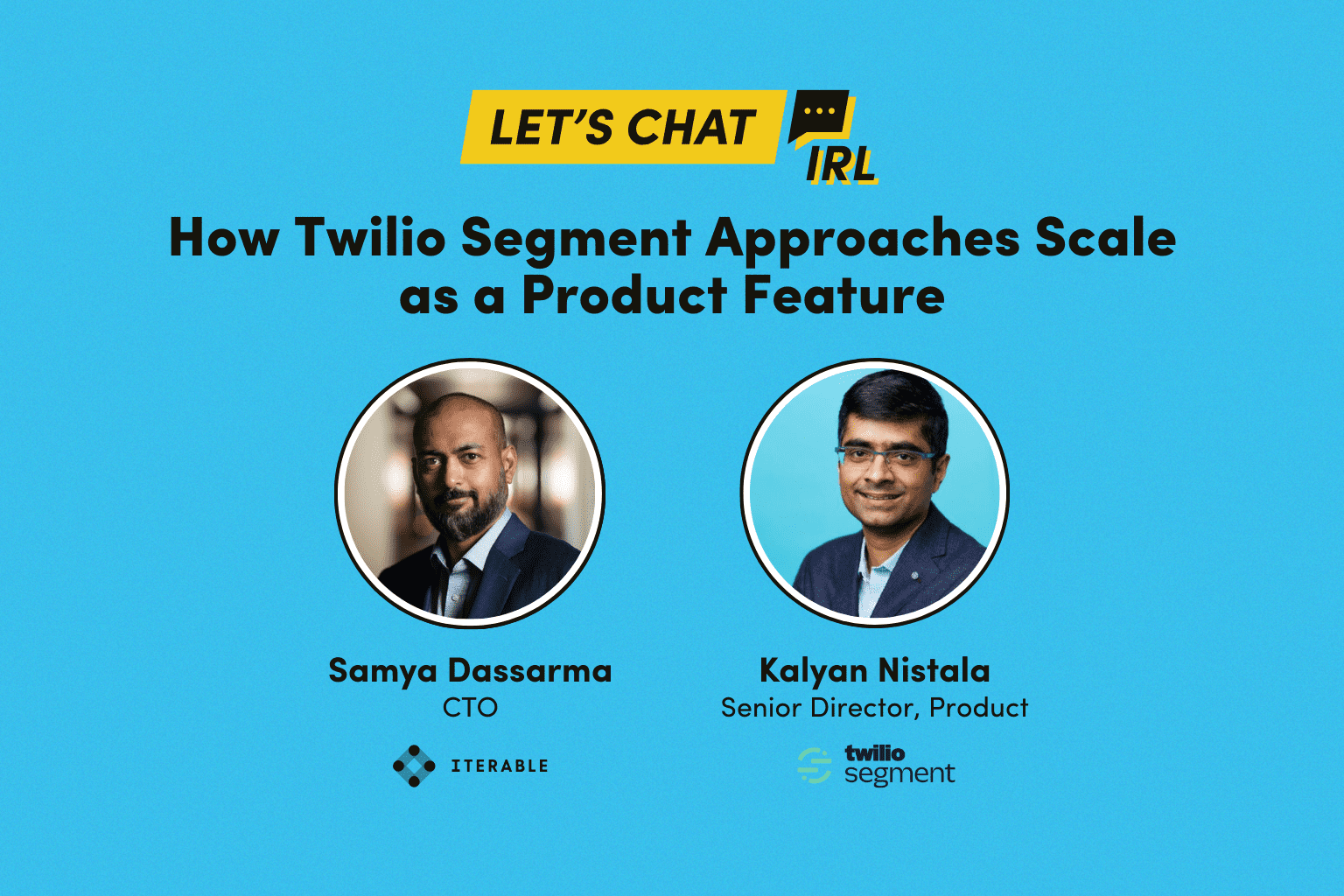
As AI accelerates how companies build and ship products, one truth remains unchanged: durable scale comes from solving real customer problems, not chasing technology for its own sake. In a conversation between Iterable CTO, Samya DasSarma and Twilio Segment Senior Director of Product Kalyan Nistala, that idea surfaces again and again—across product strategy, data foundations, and the future of customer engagement.
Building Products by Listening First
At Twilio Segment, product leadership spans far more than feature delivery. The work stretches across vision, roadmap planning, pricing, and close collaboration with go-to-market teams, all grounded in continuous customer conversations. Enterprise customers, in particular, shape how the product evolves, not just through feedback on what exists today, but through clarity on where their data challenges are headed next.
That constant feedback loop creates a product organization that has to move fluidly—zooming in on specific capabilities while maintaining a platform-level view of how everything fits together.
Scale Isn’t Optional When Data Is the Product
When data is the product, scale and reliability become non-negotiable. Segment’s pipelines process billions of events over short periods of time, and customers depend on those systems to work accurately, every time. That reality drives deep investment in segmentation, orchestration, observability, and infrastructure that can support complex use cases involving millions of end users.
Scale, in this context, isn’t about growth for growth’s sake. It’s about trust. Reliability and uptime aren’t background concerns—they’re fundamental to whether customers can act on their data with confidence.
A Lesson From Amazon: Start Small, Measure, Iterate
Despite operating at massive scale today, some of the most enduring lessons about product building come from starting small. Early experiences at Amazon reinforced a mindset that still holds: meaningful products often begin as modest experiments, validated through real customer use before being scaled up.
The focus isn’t on launching something perfect. It’s on identifying a clear customer pain point, forming a hypothesis, testing it with a small group of partners, and measuring whether it actually delivers value. Iteration, guided by data, becomes the engine of progress.
Where Companies Go Wrong: Weak Data Foundations
Many organizations now want AI-driven outcomes as quickly as possible, but speed can mask fragility. Data collection and storage are rarely the hardest parts of the problem. The challenge lies in deciding what data truly matters, structuring it correctly, and ensuring it’s usable for real activation.
Without that discipline, even the most advanced tools fall short. Strong data foundations take time, but they’re what separate short-term wins from long-term success.
Why Data and Messaging Have to Work Together
This is where the partnership between Twilio Segment and Iterable comes into focus. Data orchestration brings together signals from across systems to form a unified customer profile. Messaging orchestration turns that profile into timely, relevant communication across channels.
Together, they help customers move beyond collecting data toward acting on it—connecting insight to engagement in real time.
Looking Ahead: AI, Privacy, and Richer Customer Context
As expectations for AI rise alongside concerns about privacy and trust, the future of customer engagement will depend on context. Richer profiles informed by real-time interactions across channels create opportunities to respond to customers as moments happen, not after the fact.
The shift away from rigid campaign calendars toward moment-based engagement reflects a broader truth: the most powerful systems won’t be the fastest or flashiest. They’ll be the ones built patiently, on strong foundations, with a clear understanding of the people they serve.
In the race toward what’s next, the real differentiator may be the willingness to slow down just enough to build it right.