































Traditional upsell and cross-sell tactics were built for e-commerce and one-time purchases, where value is immediate and transactions are discrete. Add an item to the cart. Push an upgrade at checkout. Move on.
But consumer apps and marketplaces work differently. The product is engagement itself. Every interaction shows the user how the product fits into their life, opens up new ways to use it, and reinforces trust. Value compounds through use, not purchase. When upgrades are pushed before that value is clear, users disengage quietly, question intent, and leave future revenue unrealized.
Simply put, expansion goes beyond asking for more by showing what’s next, at the right moment, based on real user behavior.
|
If you’re rethinking how expansion fits into your lifecycle strategy, explore how modern consumer apps design engagement systems that adapt in A Look at Consumer App Marketing Today. |
Why Traditional Upsell Tactics Don’t Work for Consumer Apps
Habit-formation research shows that habit strength can increase over time when apps support repeated behaviors in consistent contexts, with measurable improvements observed at the 1-, 3-, and 6-month marks. Progress builds through reinforcement, repetition, and fitting with the user’s context, not through isolated nudges.
This requires a mindset shift:
- From measuring interest by clicks to reading intent through behavior and usage signals
- From scaling expansion through volume to scaling through adaptability
- From persuading users to upgrade to making the upgrade obviously relevant
In consumer apps and marketplaces, users buy outcomes, not features: progress, confidence, momentum, relief. That means modern upsell and cross-sell strategies don’t start with, “What email should we send?” They start with three product-first questions:
- What just happened in the product?
- What signal did the user give us?
- Is this a moment of success, friction, or hesitation?
The 4 Expansion Motions Modern Consumer Brands Use
Smart consumer brands no longer run “upsell campaigns” in isolation. They design expansion moments that align with how users experience value. These four expansion motions replace traditional upsell and cross-sell thinking with lifecycle-first execution.
1. Activation-Driven Upsell
Activation-driven upsells extend after value has been proven. The product delivers an early outcome, the user feels momentum, and the expansion offer extends that progress instead of interrupting it.
The key principle: expand while confidence is high.
What triggers it
- A first meaningful action (e.g., first deposit, first booking, first completed task)
- A clear activation milestone
- Repeated use of a core feature that signals intent
What it replaces
- Early “upgrade now” prompts during onboarding
- Welcome-series upsells before value clicks
In fintech, for example, a first deposit marks a psychological shift. The user has moved from exploring to committing. At that moment, surfacing personalized investment tools or advanced insights builds on action already taken. The upgrade feels like progression — not persuasion.
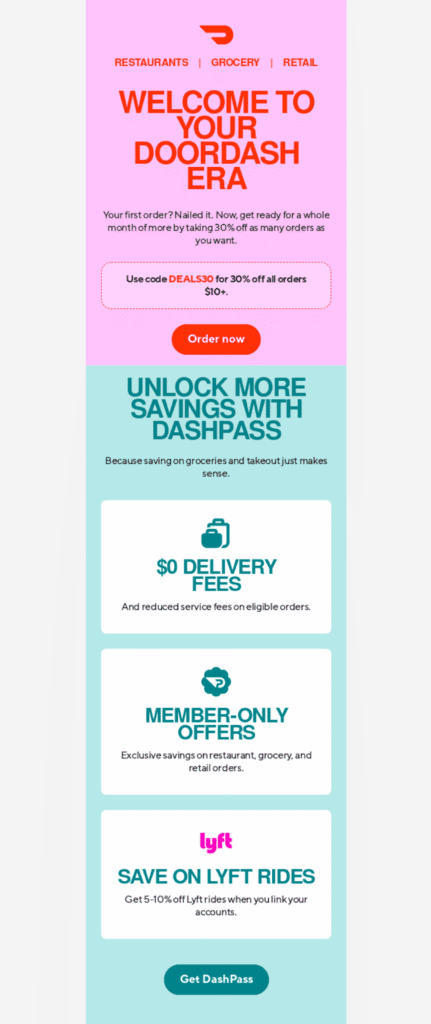
The same logic applies in digital marketplaces. After a successful first order, delivery apps often introduce their subscription tier. In the example below, DoorDash surfaces DashPass immediately after a completed order. The message extends the win: savings and convenience on the next order, not abstract benefits disconnected from context.
Source: Really Good Emails
It doesn’t say “upgrade because we offer features.” It says: “You just used this successfully — here’s how to make it even better next time.”
2. Behavior-Based Cross-Sell
Behavior-based cross-sells follow patterns users have already established. They respond to what people consistently engage with, not what a catalog wants to promote. The product watches what users do, spots related needs, and shows options that fit naturally into existing routines.
The key principle: amplify demonstrated behavior, don’t redirect it.
What triggers it
- Repeated engagement within a specific category or feature
- Consistent focus on one type of content, product, or workflow
- Exploratory behavior clustered around related actions
What it replaces
- Static “recommended for you” modules
- Broad “you might also like” emails sent to everyone
- Catalog-driven cross-sells disconnected from usage
For example, in fitness apps, users who regularly complete strength workouts show commitment to performance. Introducing mobility or recovery programs at that point supports better outcomes without asking users to change goals or habits. The recommendation feels supportive, not distracting.
Media and subscription businesses follow the same principle. In the example below, Everand (formerly Scribd) responds to a reader who consistently engage with a specific author with curating recommendations based on recently read titles, subject matter, tone, and literary style.
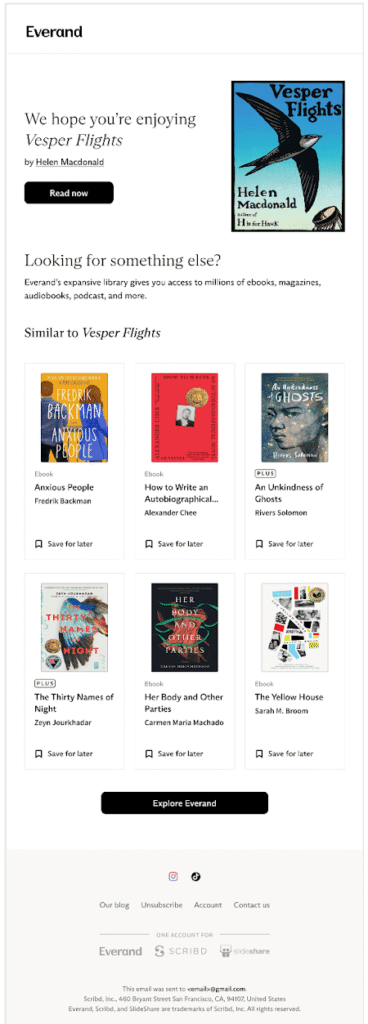
This motion doesn’t try to spark new interest. It builds on existing intent. The user doesn’t feel redirected, but rather, understood.
3. Friction-Based Expansion
Friction-based expansion appears when progress stalls. The user is trying to get something done, hits a limit, and feels the cost of stopping. The upgrade exists for one reason: to remove the obstacle that just appeared and let work continue without interruption.
The key principle: meet resistance with relief.
What triggers it
- A usage cap or restriction is reached
- A trial period ends after active engagement
- A workflow slows, stalls, or requires a workaround
What it replaces
- Pricing-page-only upsells
- Blanket premium messaging disconnected from real usage
- Generic “upgrade anytime” prompts
The same pattern shows up across verticals. In marketplaces, a service provider who reaches a lead cap has already proven demand. Upgrading becomes a way to keep earning. In digital publishing, a reader hitting a paywall mid-article experiences friction in the moment of engagement. A subscription offer framed around continued access resolved the interruption.
In productivity tools like Calendly, friction becomes visible when a trial ends after meaningful use. The user has already integrated scheduling into their workflow. When the 14-day trial expires, the product surfaces an upgrade framed around “keep using the premium features you love.”
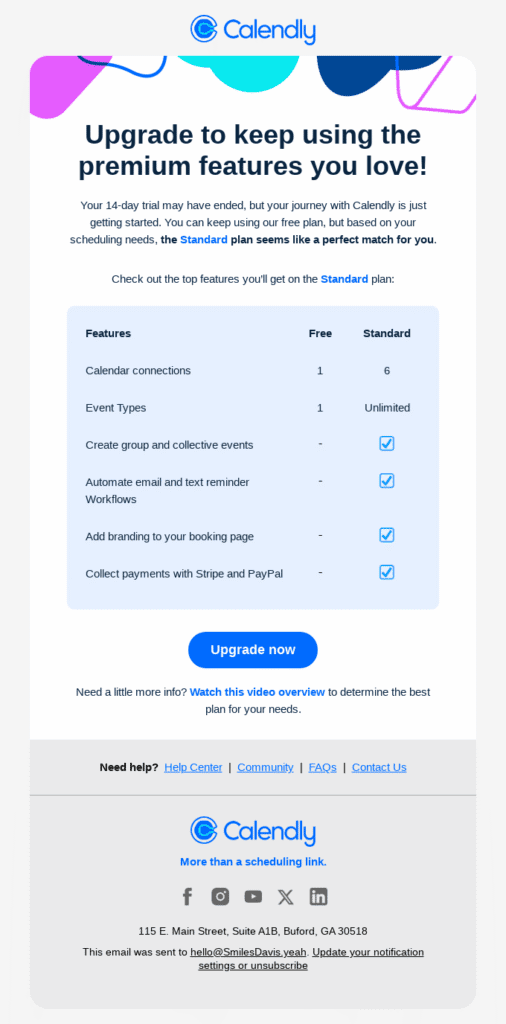
Source: Really Good Emails
When users hit friction, they’re often ready to upgrade. Center the problem, deliver relief, and let the upgrade remove what stands in the way.
4. Trust- and Habit-Based Expansion
Trust-based expansion happens after the product becomes part of a routine. Usage stabilizes. Confidence builds. The user is no longer testing whether the product works — they assume it does.
That shift from testing to relying is what turns usage into habit. Research on habit formation shows measurable gains in habit strength at 1-, 3-, and 6-month intervals, especially when products reinforce behavior consistently within the user’s context. Expansion at this stage should feel like continuity, not escalation.
The key principle: protect and reinforce what users don’t want to lose.
What triggers it
- Consistent usage over time
- Milestones reached (streaks, anniversaries, retention benchmarks)
- High-trust actions completed (profile setup, preferences saved, verification completed)
What it replaces
- Renewal pressure tactics
- Discount-led upgrade pushes
- Urgency messaging disconnected from behavior
Again, this motion works in almost every industry. In educational tech, a learner who completes daily lessons for two weeks demonstrates discipline and commitment primed for premium experiences like personalized study paths and progress tracking.
The same pattern appears in marketplaces like OpenTable. In the example below, OpenTable identifies users aligning with nonalcoholic or “stay on track” dining behavior and surfaces a relevant partnership with Athletic Brewing. This motion works because it treats expansion as recognition.
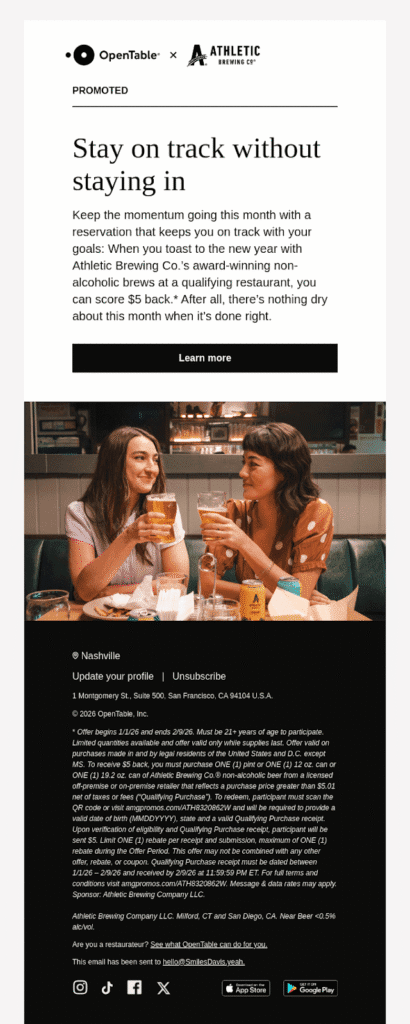
Source: Really Good Emails
When users feel understood and supported in the habits they’ve built, deeper engagement (and long-term revenue) follows naturally.
Mapping Modern Expansion to Familiar Campaigns
Modern expansion doesn’t replace familiar campaigns so much as it rewires how they work. What used to live in isolated moments now follows user behavior in real time.
|
Traditional Campaign |
Modern Expansion Motion |
| A welcome-series upsell once asked for commitment before value was clear. |
Activation-driven upsells wait until users experience success, then extend momentum while confidence is high. |
|
Product recommendation emails used to broadcast “you might also like” to everyone. |
Behavior-based cross-sells respond to repeated actions, reinforcing what users already choose to do. |
|
Pricing pages once carried the full burden of upgrades, assuming users would self-identify readiness. |
Friction-based expansion moves that decision into the workflow, appearing exactly when limits, delays, or workarounds interrupt progress. |
|
Renewal discounts relied on urgency and price pressure to force a decision. |
Trust-based expansion recognizes habit and reliance, positioning growth as continuity rather than rescue. |
The shift is subtle but decisive. Expansion moves from static campaigns to responsive systems, from persuasion to alignment, and from guessing intent to acting on proof. The result feels familiar to marketers and natural to users, which is precisely why it works.
Expansion That Feels Like the Product
Expansion works when it follows the experience users are already having. Successful brands treat upsell and cross-sell as part of the product itself, not as messages layered on top. Growth comes from recognizing progress, friction, and habit in real time and responding with support that keeps momentum intact. When those moments are missed, users rarely complain or cancel loudly — they just drift away.
|
Ready to turn expansion into sustained growth? Download A Look at Consumer App Marketing Today to see how leading consumer apps increase active users, grow adoption, and scale recurring revenue through adaptive lifecycle engagement. |