
In the early 1900s, the last Sunday of every February was considered International Women’s Day. Women of Manhattan gathered on this day to discuss prevalent matters. Shortly after, Germany—followed by the rest of Europe—declared International Women’s Day a national holiday. Then, after continued rallying, in the 1970s the United States also recognized International Women’s Day as a national holiday.
In the 1980s, a task force in California created a Women’s History Week to get more schools to comply with Title IX laws, which had recently been passed. As a result, President Jimmy Carter declared March 8th the beginning of Women’s History Week. By the late 1980s Congress had declared the entire month of March to be Women’s History Month. And, here we are today—recognizing March as Women’s History month and March 8th as International Women’s Day.
But, there’s still a lot of work to be done. As an example, according to an article in Fortune, only 8% of CEOs are female. What’s more, the gender gap will take a while to close—especially after Covid-19. As the 2021 Global Gender Gap Report mentions, as a result of the pandemic, “it will take an average of 135.6 years for women and men to reach parity on a range of factors worldwide, instead of the 99.5 years outlined in the 2020 report.”
So what can we, as brands, do with this information? How can brands recognize Women’s History Month without seeming disingenuous and cashing in on a good cause? After touching upon authentic marketing during Black History Month last month, we wanted to look through the same lens at marketing during Women’s History Month.
Creating Meaningful Email Campaigns
Last year, in our article during Women’s History Month, we featured three key aspects of creating meaningful email campaigns: honoring women customers, spotlighting women employees, and highlighting company efforts to support women’s initiatives. To reflect on last year’s advice, we pulled some examples from this year’s campaigns, to see how they stack up.
Honor Women Customers
To honor women customers, Fabletics, a subscription athletic apparel brand, is offering a free tee shirt that says “She Can Do Anything” with any order (for VIP customers). The goal of the tee shirt, as described below the image, is to empower any woman that wears it and any woman that sees it.
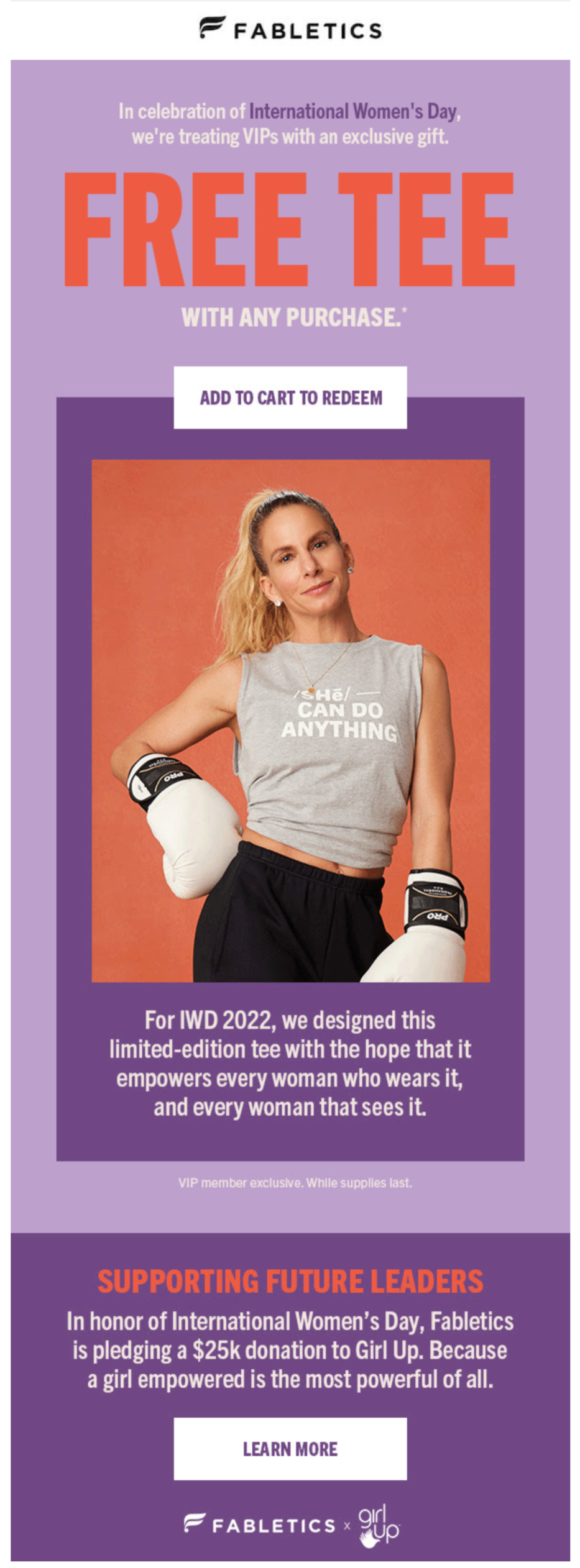
But, that’s not all. In addition to giving away a free gift to inspire customers, Fabletics pledged to donate $25k to Girl Up, a foundation dedicated to advancing girls’ skills, rights, and opportunities to lead. Providing a free gift to loyal customers and donating a portion of their earnings to a women-centric organization shows authenticity and understanding of their audience.
Spotlight Women Employees
While not necessarily employees, Michael’s, the art supply store, sent out an email highlighting some of the women-owned brands they carry in-store and linked directly to their product pages. This email features four separate female-owned brands with a short bio about each of the owners and a link to shop their products.
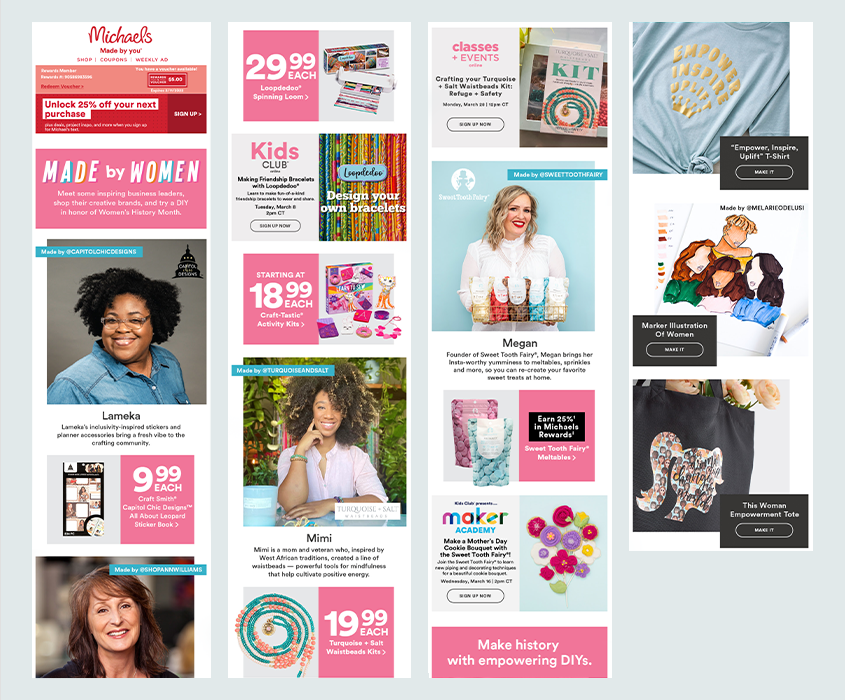
In addition to highlighting some of the women-owned brands they carry, Michael’s offered up some on-brand DIY projects to empower their women customers. This includes a DIY T-shirt, drawing, and tote bag—all meant to inspire their audience.
Highlight Company Efforts to Support Women’s Initiatives
Drizly, an alcohol delivery service, has always put out clever campaigns regardless of the month, but their push notification for Women’s History Month caught our attention. To celebrate their efforts in supporting women’s initiatives, Drizly called out women-owned beer, wine, and spirit brands. When clicked, the push notification opens a deep link to a page featuring only women-owned brands. This is slightly different from Michael’s since Drizly doesn’t hold the inventory, but instead, works with local liquor stores to connect with customers.
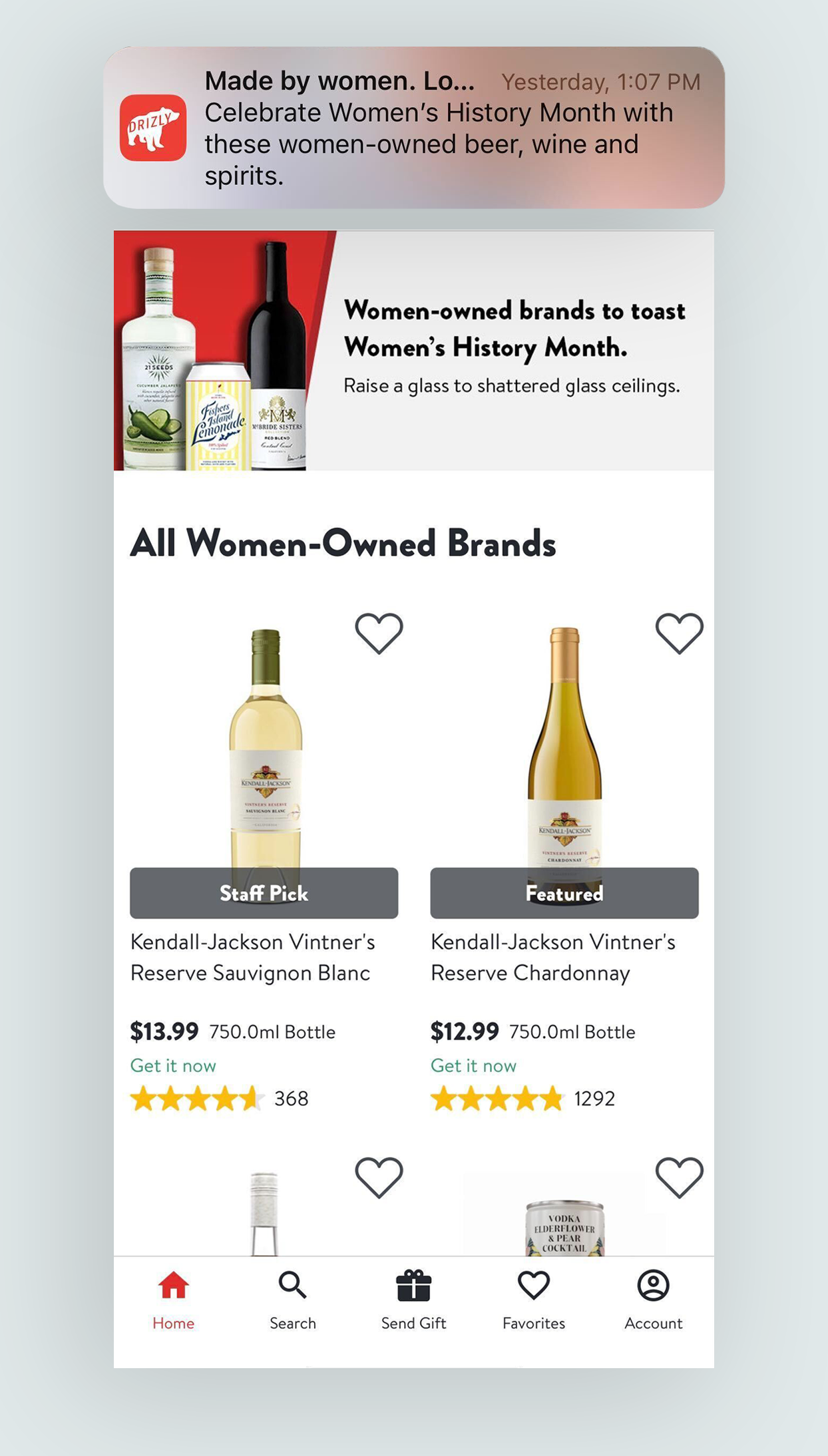
We appreciate this approach to marketing for Women’s History Month because at the end of the day, the goal is to benefit these women-owned businesses. Drizly makes money regardless of whether you shop from women-owned businesses or not, but showing that they 1) recognize the brands that are women-owned and 2) want to help support those brands demonstrates that Drizly went out of their way to try to support women’s initiatives.
Empowerment and Impact at Iterable
Lindsay Kaplan, co-founder and Chief Brand Officer of Chief, a private membership network focused on connecting and supporting women executive leaders, writes, “There are 5 million executive women in the United States right now—women who are ready to take the helm of companies, to serve on boards, to run for office. If we want to do it, we can change the world today. Promote them. Open the doors. Give them a seat at the table.”
This #WomensHistoryMonth, we’ll be honoring and sharing the stories of some of the incredible women across Iterable on our social media who are #DefyingGravity, defending their worth, growing their ambition, and winning in the workplace. They’re the leaders of Iterable’s marketing team of today and the marketing executives of tomorrow.
We are also proud to be in the midst of our inaugural Women’s Empowerment Conference, (March 7-10), which is designed to connect, educate, and empower women and allied Iterators, partners, and customers. The conference began with a keynote address from New York Times bestselling author and NPR podcast personality, Stacey Vanek Smith, on key takeaways from her book, Machiavelli for Women. Throughout the conference, attendees have the opportunity to join sessions and events like Speed Networking and Development Discussions, meant to equip women with the tools they need for growth and success.
Like we mentioned, The World Economic Forum shared that it will take over 135 years to reach global gender parity. That’s far too long! Working together, let’s aim to change that.