

Increase in retention of month-to-month paying users with Iterable
“Centralizing in-app messaging, push messaging, and email on one platform, with a unified customer profile view, enables us to seamlessly engage across our digital and physical universe.”
Brian Schmidt
Director of CRM, Growth & Retention @Fender
In This Story
Have a Question?
At Iterable we’re committed to supporting you every step of the way.
Fender was founded in 1946 by Leo Fender, a radio repairman whose experiments with Hawaiian lap steel guitars grew into the world’s leading guitar manufacturer. Over 70 plus years, Fender has produced some of the most iconic guitars and amps in the history of American music: Princeton Reverb® amplifiers, the Telecaster®, the Precision Bass®, and of course, the Stratocaster®. These instruments have been played by legends like Jimi Hendrix and Eric Clapton and can be found on every festival and rock or jazz club stage.
Challenge
Fender has inspired millions of people to learn to play guitar. However, for most aspiring players, the initial burst of inspiration fades quickly—90% of first-time players quit within six months. This retention problem led Fender to begin investing in digital properties four years ago. The company now has three different mobile apps—Fender Play™, Fender Tune™, and Fender Tone™—as well as a direct-to-consumer business and e-commerce platform; however, the majority of its business is done with local musical instruments dealers around the world.
Fender Play is a digital learning subscription app that helps people pick up skills and start a lifelong relationship with guitar, bass or ukulele; Fender Tune is an intuitive digital guitar tuner with several added features for pros/advanced players; and Fender Tone works hand-in-hand with the brand’s Mustang GT digital modeling amps to help players explore guitar tones from their favorite artists and create their own
There’s a whole journey from learning the first chords to the first performance that Fender can help facilitate. Our goal is to help people develop a lifelong relationship with guitar, and that means engaging them on digital.
Brian Schmidt
Director, CRM & Retention, Fender
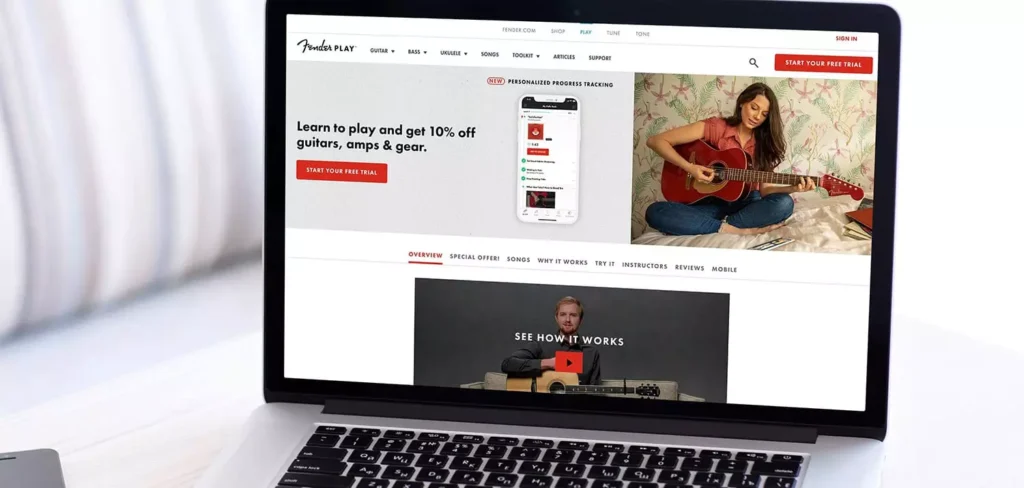
With these digital properties, Fender wanted to do more than sell guitars—it wanted to become a mentor that provided customers with the education, information, and support they needed to pursue their passion for music. Beyond subscription revenue, Fender aimed to develop the lifetime value potential of any given guitar player and create a customer journey that would last for decades. To accomplish that goal, Fender needed holistic insight into the customer journey.
However, because Fender started out as a manufacturer of physical products and because it’s digital ecosystem was built quickly, the company had a siloed tech stack with user data spread across many disparate locations. Its old email provider, for example, didn’t integrate with its data layer. When someone signed up for Fender Play, the system didn’t know what instrument or genre they were playing, or if they were even playing at all.
Fender also had a separate solution for pushing in-app messaging that didn’t know what was happening on the website or in the other Fender apps, because they were all in separate locations. All the disparate silos meant the data could not be made actionable to create a more meaningful, engaging, personalized customer experience that drove retention.

Solution
Fender wanted to own its relationships with customers and evolve how it thought about LTV to encompass instrument sales, app subscriptions and engagement, and in-app purchases. The marketing team set out to map the customer journey and identify opportunities for engagement and potential drop-off points. By working with Iterable, Fender was able to consolidate all customer information across all digital sources into one unified customer profile. If a customer is watching a video in Fender Play or buying something on (Fender.com) or connected to their digital amplifier, the company can use that data to deliver a more personalized experience. Collectively, all these data points provide insight into a customer’s offline behavior with their guitar, such as how often they play, and make it actionable, creating a feedback loop.
Fender uses Iterable as a growth marketing platform for email and mobile messaging. This enables Fender to deliver cross-channel campaigns that drive offline behavior with online engagement. Take onboarding, for example. Fender uses Iterable’s Studio to onboard new customers in Fender Play. A customer comes in—either from iOS, Android, or the web—and chooses to start a free trial. Then Fender activates their messaging journey. Based on what instrument they’re playing, what genre they’re playing, how much they’re playing, and what platform they’re on, Fender’s marketers make decisions around the types of messages to send them.
Results
Fender has seen improvements in retention of a month-to-month paying user because of engagement with videos. 89% of users watch a video on their first day. Through a personalized onboarding experience, Fender has seen an increase in engagement, encouraging people to watch more videos, learn more guitar, and then stick around as a paying member.
Director, CRM & Retention, Fender
Iterable allows us to drive the customer journey in a completely different way than we were able to before. Centralizing in-app messaging, push messaging, and email on one platform, with a unified customer profile view, enables us to seamlessly engage across our digital and physical universe. With all our data in one place, we can strategically drive lifetime value.
Brian Schmidt